Art Institute of Chicago
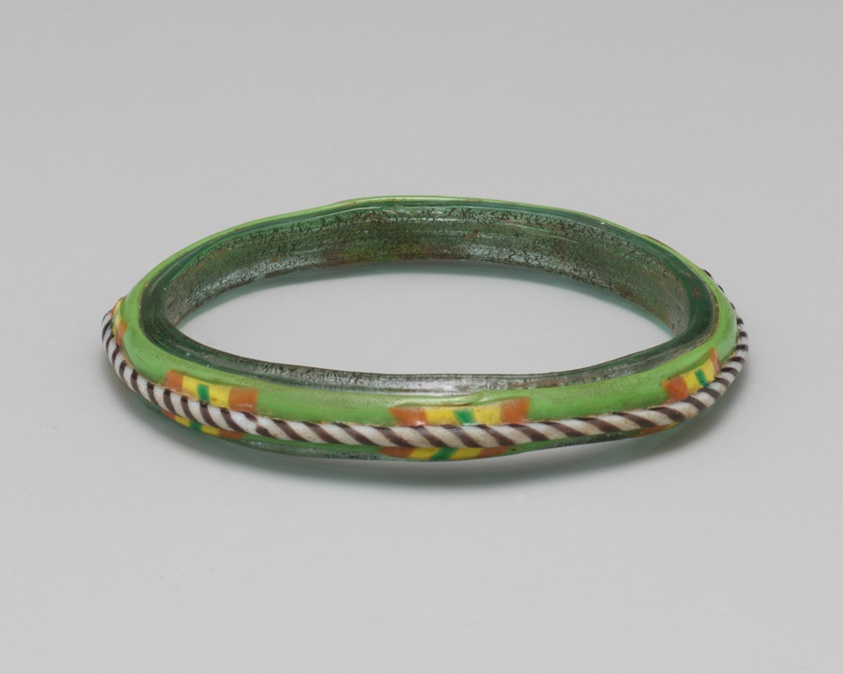
Bracelet
IslamicLinkedCulture matchlcp-8022cbd33389
- Date
- 14th-15th century
- Medium
- Glass
- Department
- Arts of Africa
- Institution
- Art Institute of Chicago
- Object ID
- 823
From the Art Institute of Chicago record
For hundreds of years, women up and down the eastern coast of Africa wore bracelets like these as highly fashionable accessories. Simple monochromatic glass bangles first became common in Egypt beginning in the Ptolemaic Period (332–30 BCE), with multiple color chips and new designs emerging during the Roman period (30 BCE–395 CE). After the arrival of Islam in the 7th century, elaborately designed bracelets became the norm. In the 17th century, artists began to add a multicolored spiral band on the outside of each bangle, seen here in black and white. Glass workshops continued to produce such bangles until the end of the 19th century.
The authoritative record is held by Art Institute of Chicago. LinkedCulture surfaces this object and its connections; it does not alter institutional metadata.
Get printable QR codesHide QR codes
Open QR codes for this object page and the museum record. They stay collapsed until needed.
Provenance & credit
As published by the source institution. Coverage varies — not every institution's open-data feed includes ownership history.
- Credit line
- Purchased with funds provided by Henry H. Getty and Charles L. Hutchinson
- Provenance
- Reverend Chauncey Murch (1859-1907), Luxor, Egypt; sold to the Art Institute of Chicago, 1894; price reimbursed by Henry H. Getty and Charles L. Hutchinson, 1894.
Linked open data
Authority identifiers that link this record into the wider web of cultural data — stable references you can follow to the source.
- Object type
- AAT300209261
Related across collections
Semantically similar works from Art Institute of Chicago and other institutions.