Art Institute of Chicago
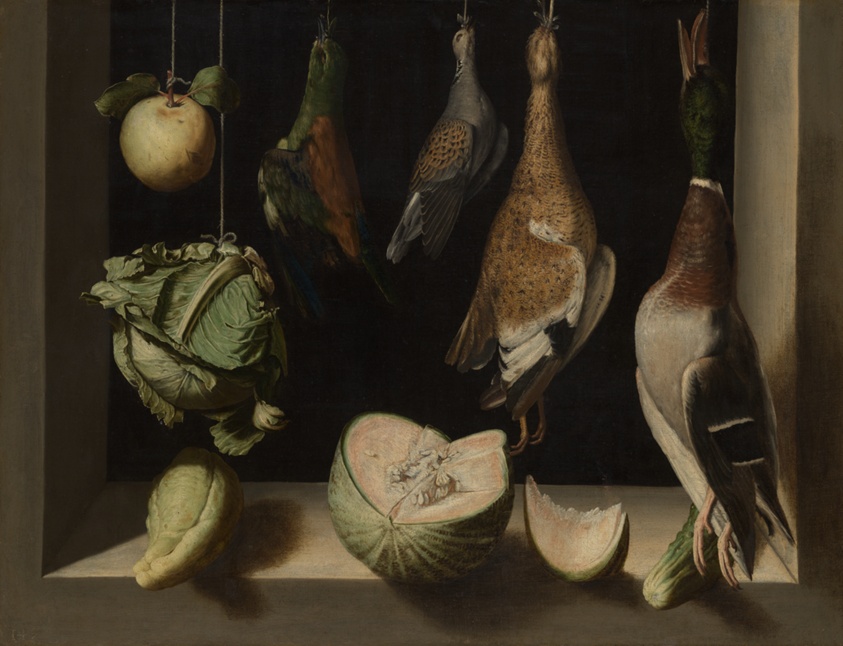
Still Life with Game Fowl
Juan Sánchez Cotán (Spanish, 1560–1627)LinkedCulture matchlcp-2a6532686929
- Date
- c. 1600–3
- Medium
- Oil on canvas
- Culture
- Spain
- Department
- Painting and Sculpture of Europe
- Institution
- Art Institute of Chicago
- Object ID
- 84709
From the Art Institute of Chicago record
Still Life with Game Fowl is the Art Institute’s earliest European still-life painting. Still life emerged as an independent genre in European art in the sixteenth century, when artists began to specialize in such categories as landscape, portraiture, and scenes of everyday life. Some, like Juan Sánchez Cotán, became interested in displaying their skill at depicting inanimate objects, in part as an expression of the order and variety of the natural world. The painter’s focus changed in 1603, however, when he left a successful, two-decade artistic career in the Spanish city of Toledo to become a lay brother of the Carthusian order at the Charterhouse of Granada. Accordingly, he changed his focus from still lifes to religious images. This painting was executed just before Sánchez Cotán left Toledo. It follows the conventional format of his still lifes: precisely rendered forms displayed in a shallow niche. In some works, he depicted few objects; in others, such as this example, he filled the space with them. The artist rigorously organized the composition so that the complex symmetry of the objects echoes the elegant geometry of the spherical quince, cabbage, and melon and the conical birds. A strong, raking light creates a lively play of brightness and shadow over each shape. This arrangement is further enlivened by a subtle compositional device—the hanging objects form a diagonal from the top-left to bottom-right corners of the niche. In these ways, Sánchez Cotán infused simple objects in a minimal setting with great presence.
The authoritative record is held by Art Institute of Chicago. LinkedCulture surfaces this object and its connections; it does not alter institutional metadata.
Get printable QR codesHide QR codes
Open QR codes for this object page and the museum record. They stay collapsed until needed.
Provenance & credit
As published by the source institution. Coverage varies — not every institution's open-data feed includes ownership history.
- Credit line
- Gift of Mr. and Mrs. Leigh B. Block
- Provenance
- Probably in the artist’s possession, Toledo, before he retired to a Carthusian monastery, in August 1603 [inventory 1603, no. V, (“Un lienzo de frutas adonde está el ánade y otros tres pájaros ques de Diego de Valdivieso”; Jordan in Madrid 1992, pp. 41–43); probably Diego de Valdivieso, Toledo, 1603 [see 1603 inventory cited by Jordan 1992]. Cardinal Bernardo de Sandoval y Rojas, archbishop of Toledo and primate of Spain, Toledo or Huerta de Sandoval, near Madrid (died 1618); acquired from his estate with 4 other still lifes for the decoration of the Galería del Mediodía in the royal hunting lodge of El Pardo, the series completed by an additional still life commissioned for this purpose from Juan van der Hamen [according to a note of 10 September 1619 in the accounts of the royal household; see José María de Azcárate, “Algunas noticias sobre pintores cortesanos de siglo XVII” Anales de Instituto de estudios Madrileños, 6 (1970), p. 60; see also Jordan 2006, pp. 54-58,]; royal inventories of 1653, no. 145 (“145. Un frutero Pequeño Con su marco de oro y negro y un Melon abierto en medio”, A small fruit still life with its black and gold frame with an open melon in the middle; an inventory number 145 is inscribed in the lower left corner of the painting; see Jordan 2006, pp. 58, 300, n. 24) and 1701/03, no. 132 (Fernández Bayton 1981, vol. 2, p. 144, no. 132); probably one of two still lifes by Cotán listed among the paintings from royal residences gathered at the Escorial in 1809 for shipment to Madrid for a projected national museum [Jordan 2008, pp. 136-37 and Ilse Hempel Lipschutz, Spanish Painting and the French Romantics, Cambridge, Mass., 1972, pp. 268-81, especially p. 280]. August L. Mayer, Munich, by 1922 [see Mayer 1922, p. 361]; sold, Munich, Hugo Helbing, November 24–25, 1933, lot 79, pl. 4, as Sánchez Cotán, Küchenstilleben for 380 Marks [the price based on Die Weltkunst 1933; that the picture belonged to Mayer can be deduced from the provenance of no. 74 in this sale, which later entered the Bayerische Staatsgemäldesammlungen]. Private collection, Germany [according to 1955 receipt from Frederick Mont, in curatorial file]. Frederick Mont and Newhouse Galleries, New York, by 1955 [1955 receipt cited above and shipping invoice, in curatorial file]; sold to the Art Institute, 1955.
Linked open data
Authority identifiers that link this record into the wider web of cultural data — stable references you can follow to the source.
- Object type
- AAT300033618
Related across collections
Semantically similar works from Art Institute of Chicago and other institutions.