Art Institute of Chicago
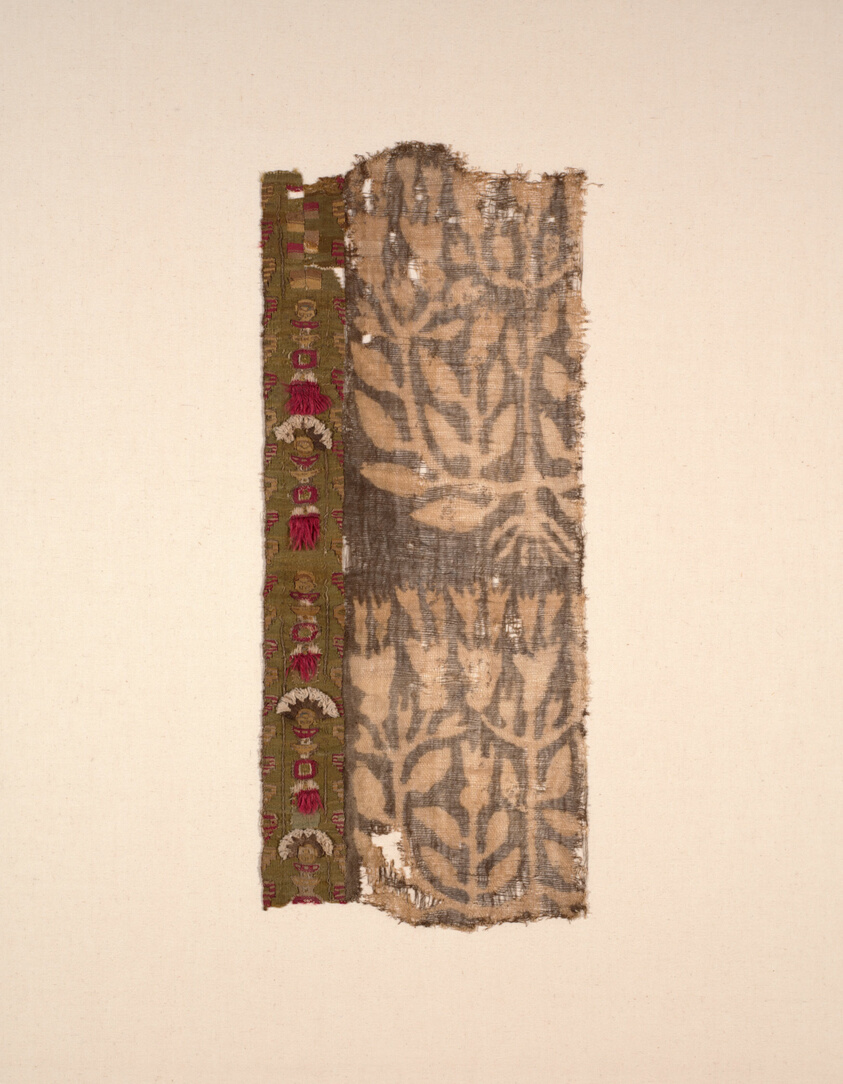
Fragment
LambayequeLinkedCulture matchlcp-02193ff02dd7
- Date
- 1000-1476
- Medium
- Cotton, plain weave; resist dyed; edged with cotton and wool (camelid), slit tapestry weave with couched supplementary weft loop pile; appliquéd with cotton, slit tapestry weave with extended weft cut fringe; embroidered with cotton in interlaced running stitches
- Culture
- Peru
- Department
- Textiles
- Institution
- Art Institute of Chicago
- Object ID
- 85247
From the Art Institute of Chicago record
The narrow border of this fragment is embroidered with stylized anthropomorphic or zoomorphic figures with appliquéd headdresses. The main panel was filled with large plant designs produced using a resist dyed technique. Unlike the motifs and contained within the border, the style and technique used to render these plants are not typical of the Lambayeque textile tradition, suggesting the innovation and skill of the artists who created this textile.
The authoritative record is held by Art Institute of Chicago. LinkedCulture surfaces this object and its connections; it does not alter institutional metadata.
Get printable QR codesHide QR codes
Open QR codes for this object page and the museum record. They stay collapsed until needed.
Provenance & credit
As published by the source institution. Coverage varies — not every institution's open-data feed includes ownership history.
- Credit line
- Kate S. Buckingham Endowment
- Provenance
- Eduard Gaffron (1861–1931), Lima, Peru, from 1892 to 1912, then Berlin, from 1912 [History of the Department report (Joanne Behrens, 1985) and correspondence in curatorial file]; by descent to his children Mercedes Gaffron, Berlin then Durham, SC, and Hans Gaffron (1902–1979), Berlin then Chicago [correspondence and documentation of the Gaffron Collection in curatorial file]; sold to the Art Institute, 1955.
Linked open data
Authority identifiers that link this record into the wider web of cultural data — stable references you can follow to the source.
- Object type
- AAT300014063
Related across collections
Semantically similar works from Art Institute of Chicago and other institutions.