Art Institute of Chicago
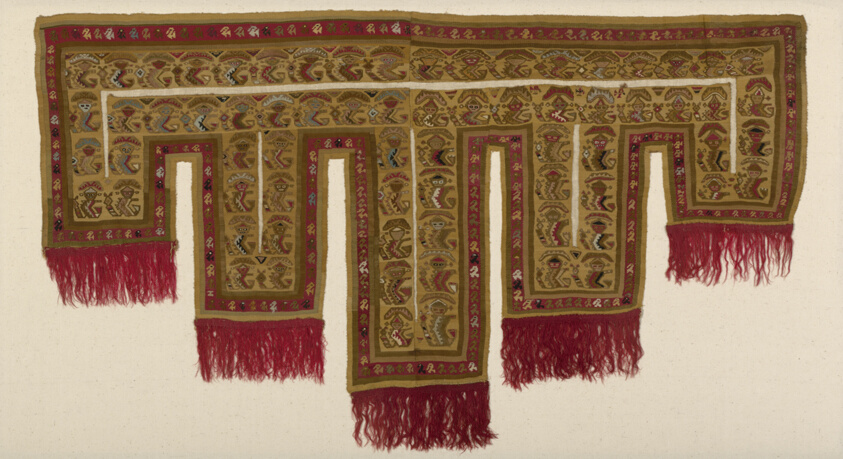
Loincloth Panel
ChimúLinkedCulture matchlcp-4791f14dd6df
- Date
- 1250-1470
- Medium
- Cotton and wool (camelid), slit tapestry weave; edged with plain weave extended weft cut fringe
- Culture
- Peru
- Department
- Textiles
- Institution
- Art Institute of Chicago
- Object ID
- 85390
From the Art Institute of Chicago record
Following the decline of their ancestors, the Moche, the Chimú emerged as one of the most powerful cultures of South America, dominating several rich valleys across the north coast of Peru for more than five centuries, from around 900 to 1465. Chimú weavers created strikingly graphic designs through the repetition of simple, abstract forms in vivid color combinations—particularly red, white, and yellow—against a solid background. Most of these textiles depict an anthropomorphic male figure wearing a "toothed" crescent headdress and holding a set of staffs—details that suggest supernatural or exalted status. This stark representation of a frontal human figure wearing an arched crown recalls the Chimú-made gold and turquoise ceremonial knife ( tumi ). The slit-tapestry panel depicts a seated animal-like figure with a long tail, arms reaching forward, and a row of spikes down its back. This being wears a similar crescent headdress, indicating a connection with the human representations on the other works. The use of repeated abstract motifs arrayed in a grid-like pattern and the stepped shape of the loincloths resemble not only the gold repoussé breastplate, but also architectural details of certain Chimú buildings, reflecting the cohesive artistic style that was presented across different media.
The authoritative record is held by Art Institute of Chicago. LinkedCulture surfaces this object and its connections; it does not alter institutional metadata.
Get printable QR codesHide QR codes
Open QR codes for this object page and the museum record. They stay collapsed until needed.
Provenance & credit
As published by the source institution. Coverage varies — not every institution's open-data feed includes ownership history.
- Credit line
- Kate S. Buckingham Endowment
- Provenance
- Eduard Gaffron (1861–1931), Lima, Peru, from 1892 to 1912, then Berlin, from 1912 [History of the Department report (Joanne Behrens, 1985) and correspondence in curatorial file]; by descent to his children Mercedes Gaffron, Berlin then Durham, SC, and Hans Gaffron (1902–1979), Berlin then Chicago [correspondence and documentation of the Gaffron Collection in curatorial file]; sold to the Art Institute, 1955.
Linked open data
Authority identifiers that link this record into the wider web of cultural data — stable references you can follow to the source.
- Object type
- AAT300209261
Related across collections
Semantically similar works from Art Institute of Chicago and other institutions.