Art Institute of Chicago
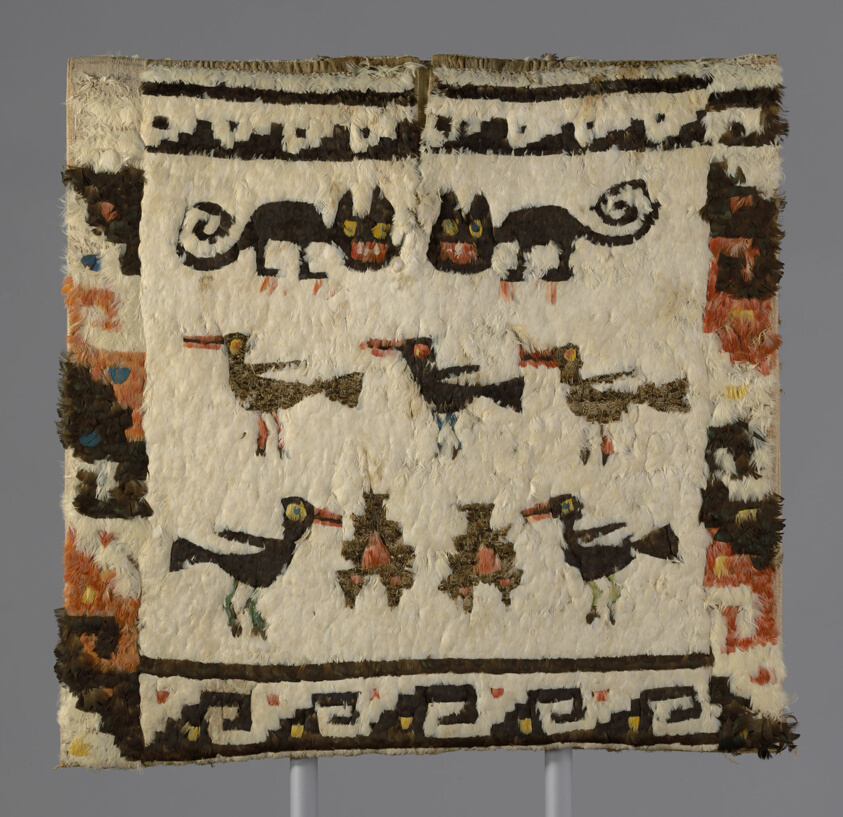
Feathered Tunic
ChimúLinkedCulture matchlcp-4791f14dd6df
- Date
- 1470-1532
- Medium
- Cotton, plain weave; embellished with feathers knotted and attached with cotton in overcast stitches
- Culture
- Peru
- Department
- Textiles
- Institution
- Art Institute of Chicago
- Object ID
- 85533
From the Art Institute of Chicago record
One of the most extraordinary works in the Art Institute’s archaeological textile collection, this feathered tunic was created by Chimú weavers in northern Peru in 1470/1532. The knee-length, sleeveless garment is composed of a plain-weave cotton cloth completely concealed by thousands of brightly colored feathers. These coveted plumes were taken from macaws, parrots, toucans, cotingas, and tanagers from the tropical forests of South America. Because they were transported across the treacherous peaks of the Andes, the feathers were extremely rare and valuable and would only have been available to the most elite members of pre-Hispanic society. Thus, the feathered tunic—with its stylized felines, birds, and fish—would have been a sumptuous emblem of power, wealth, and prestige. Like many other pre-Hispanic textiles, it was buried with its owner in a subterranean tomb on the southern coast of Peru. The dark and arid conditions in these tombs protected the tunic, thereby allowing its vibrant colors and bold motifs to endure.
The authoritative record is held by Art Institute of Chicago. LinkedCulture surfaces this object and its connections; it does not alter institutional metadata.
Get printable QR codesHide QR codes
Open QR codes for this object page and the museum record. They stay collapsed until needed.
Provenance & credit
As published by the source institution. Coverage varies — not every institution's open-data feed includes ownership history.
- Credit line
- Kate S. Buckingham Endowment
- Provenance
- Eduard Gaffron (1861–1931), Lima, Peru, from 1892 to 1912, then Berlin, from 1912 [History of the Department report (Joanne Behrens, 1985) and correspondence in curatorial file]; by descent to his children Mercedes Gaffron, Berlin then Durham, SC, and Hans Gaffron (1902–1979), Berlin then Chicago [correspondence and documentation of the Gaffron Collection in curatorial file]; sold to the Art Institute, 1955.
Linked open data
Authority identifiers that link this record into the wider web of cultural data — stable references you can follow to the source.
- Object type
- AAT300014063
Related across collections
Semantically similar works from Art Institute of Chicago and other institutions.