Art Institute of Chicago
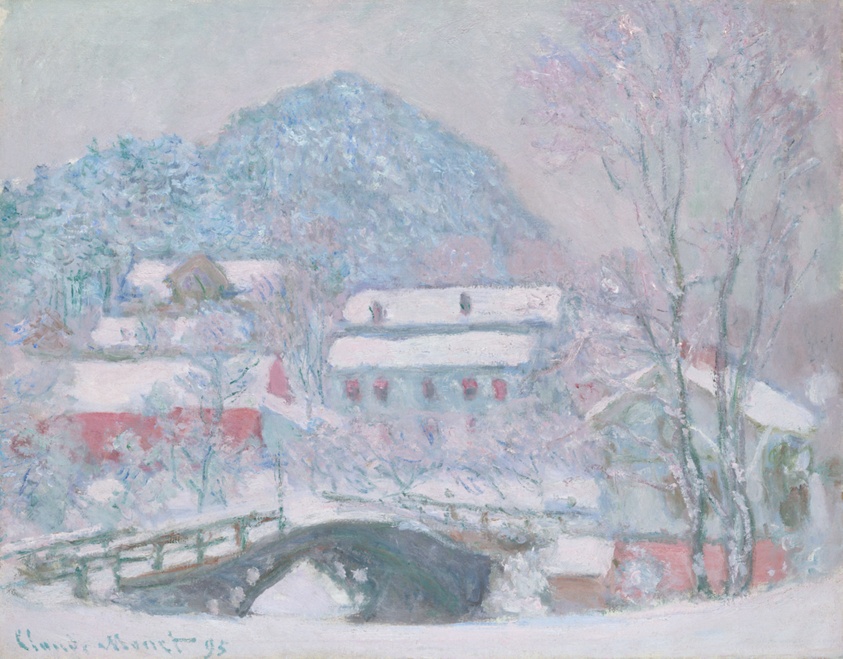
Sandvika, Norway
Claude Monet (French, 1840–1926)LinkedCulture matchlcp-8e614afd9c71
- Date
- 1895
- Medium
- Oil on canvas
- Culture
- France
- Department
- Painting and Sculpture of Europe
- Institution
- Art Institute of Chicago
- Object ID
- 86998
Claude Monet’s trip to Norway in 1895 was perhaps the most physically taxing of all his many painting campaigns. Touring the country with his stepson Jacques Hoschedé, who lived in Christiania (now Oslo), he was awestruck but initially frustrated in his search for good motifs amid the snow. Nevertheless, he painted 29 Norwegian scenes during a two-month stay. These included at least six views of Sandvika, a village near Christiania whose iron bridge may have reminded Monet of the Japanese bridge at his home in Giverny.
The authoritative record is held by Art Institute of Chicago. LinkedCulture surfaces this object and its connections; it does not alter institutional metadata.
Get printable QR codesHide QR codes
Open QR codes for this object page and the museum record. They stay collapsed until needed.
Provenance & credit
As published by the source institution. Coverage varies — not every institution's open-data feed includes ownership history.
- Credit line
- Gift of Bruce Borland
- Provenance
- The artist (d. 1926); donated to the Alfred Sisley Sale, Galerie Georges Petit, Paris, May 1, 1899, lot 65 [per Galerie Georges Petit 1899]; sold to Durand-Ruel, Paris, for 6,300 francs [per Durand-Ruel,Paris, stock book for 1891–1901 (no. 5186, as Sandviken près Christiania), as confirmed by Paul-Louis Durand-Ruel and Flavie Durand-Ruel, Durand-Ruel Archives, to the Art Institute of Chicago, Feb. 5, 2013, curatorial object file. According to Wildenstein 1996, the picture was sold on May 1, 1899, to Durand-Ruel and Bernheim-Jeune. There are two copies of this sales catalogue, annotated differently with prices and names, at the Rijksbureau voor Kunsthistorische Documentatie. One includes a notation of 6000 and Bernheim, along with a note: “tout à fait exquise”; the other only includes a notation of 6.000; see photocopies of both versions of the sales catalogue in the curatorial object file]; sold to Durand-Ruel, New York, Oct. 24 or Nov. 13, 1900 [per Durand-Ruel, Paris stock book for 1891–1901 and Durand-Ruel, New York stock book for 1894–1905, as confirmed by Paul-Louis Durand-Ruel and Flavie Durand-Ruel, Durand-Ruel Archives, to the Art Institute of Chicago, Feb. 5, 2013, curatorial object file; the Paris and New York Durand-Ruel stock books give different dates for the sale]; sold to Mrs. Harriet Borland (née Blair, d. 1933), Chicago, Feb. 13, 1901, for $3,500 [per Durand-Ruel, New York, stock book for 1894–1905 (no. 2391, as Sandviken, Norway), as confirmed by Paul-Louis Durand-Ruel and Flavie Durand-Ruel, Durand-Ruel Archives, to the Art Institute of Chicago, Feb. 5, 2013, curatorial object file]; by descent from her son, Bruce Borland, Chicago, 1933; given to the Art Institute, beginning in 1961 [The painting was given to the Art Institute of Chicago in undivided fractional interests beginning in 1961. The Art Institute received the final fractional interest for one hundred percent ownership in 1963].
Linked open data
Authority identifiers that link this record into the wider web of cultural data — stable references you can follow to the source.
- Object type
- AAT300033618
Related across collections
Semantically similar works from Art Institute of Chicago and other institutions.