Art Institute of Chicago
Lekythos (Oil Jar)
Greek; AthensLinkedCulture matchlcp-96247048df89
- Date
- about 440 BCE
- Medium
- terracotta, white-ground
- Culture
- Athens
- Department
- Arts of Greece, Rome, and Byzantium
- Institution
- Art Institute of Chicago
- Object ID
- 87669
From the Art Institute of Chicago record
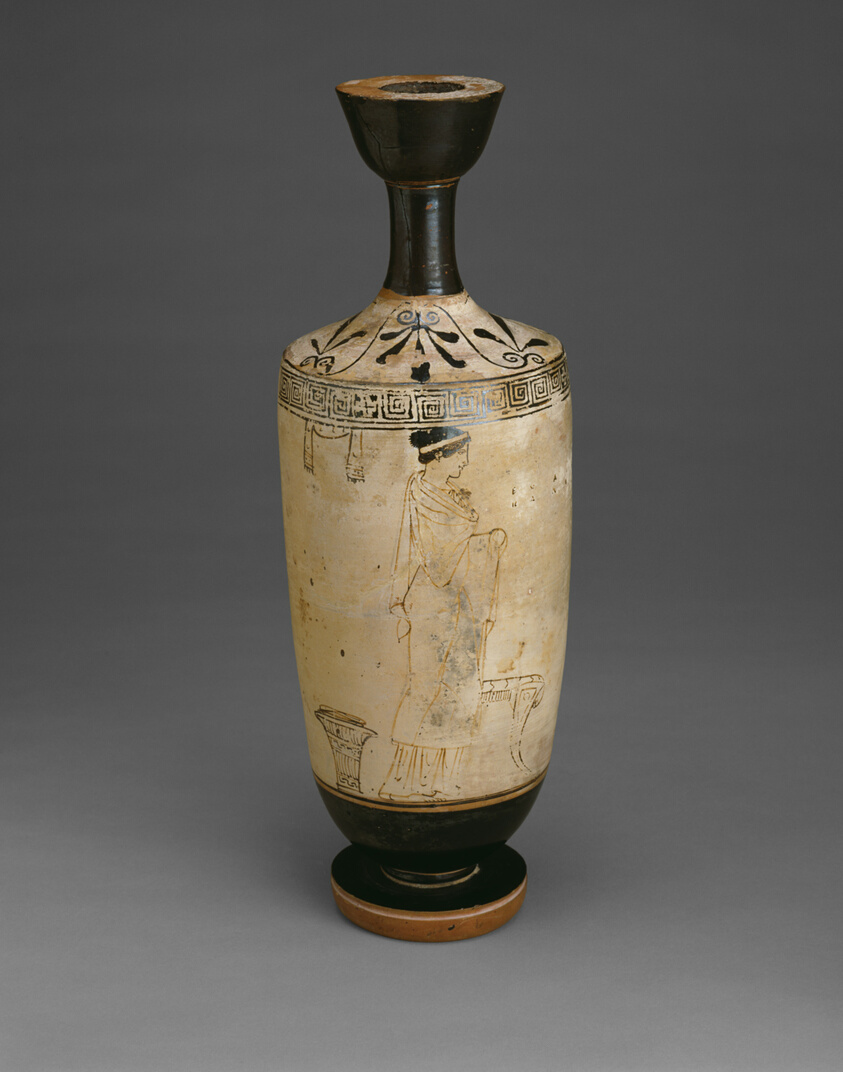
Athenian cemeteries housed a variety of monuments and offerings to the dead. This terracotta vessel, called a lekythos, is one example that held oil. From the middle until the end of the fifth century B.C., they were usually decorated in a distinctive technique known as white ground, so called after the light slip coating on the body and shoulder of the vase. Atop this, figures were usually drawn in outline and then painted in rich colors, many of which have since faded. Since most of these bottles were made for burial with the dead or to be left at their graves, the scenes on their surfaces typically represent tombs, visitors to tombs, and farewell scenes. A woman drawn in outline stands beside an empty chair. Presumably it references the absence of a loved one. A basket sits on the ground behind her. There are no remains of color. Unrelated to the scene but of interest in its own right is the inscription extending before the woman. It states that a youth by the name of Euaion is handsome. The subject of this praise is probably the son of the great Athenian dramatist Aeschylus (525–456 BC). Like his father, Euaion became a tragedian.
The authoritative record is held by Art Institute of Chicago. LinkedCulture surfaces this object and its connections; it does not alter institutional metadata.
Get printable QR codesHide QR codes
Open QR codes for this object page and the museum record. They stay collapsed until needed.
Provenance & credit
As published by the source institution. Coverage varies — not every institution's open-data feed includes ownership history.
- Credit line
- Gift of Martin A. Ryerson through The Antiquarian Society
- Provenance
- Alphonse van Branteghem, Brussels, by 1890; sold, Hôtel Drouot, Paris, May 30-June 1, 1892, lot 172, to Martin A. Ryerson (1856-1932), Chicago; given to the Art Institute of Chicago, 1907.
Linked open data
Authority identifiers that link this record into the wider web of cultural data — stable references you can follow to the source.
- Object type
- AAT300234126
Related across collections
Semantically similar works from Art Institute of Chicago and other institutions.