Art Institute of Chicago
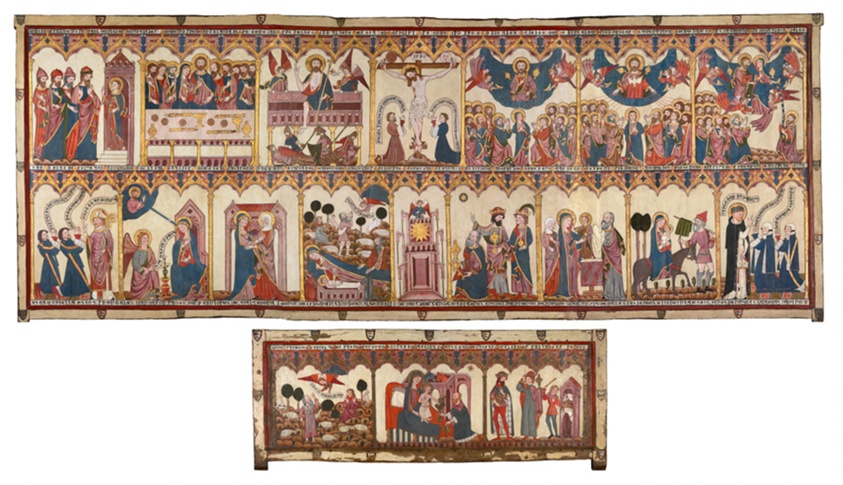
Retable and Frontal of the Life of Christ and the Virgin
SpanishLinkedCulture matchlcp-dff60d2e9f45
- Date
- 1396
- Medium
- Tempera and gold on panel
- Culture
- Spain
- Department
- Painting and Sculpture of Europe
- Institution
- Art Institute of Chicago
- Object ID
- 88793
From the Art Institute of Chicago record
This altarpiece is made up of a retable, which was set up behind the altar table in a Catholic church, and a frontal, which decorated the front of the table itself. The work is a testament to the piety of Pedro López de Ayala, who had the altarpiece made for his family’s funerary chapel in their palace in northern Spain. A major figure in the political and cultural life of late-medieval Spain, Ayala was a courtier, diplomat, and soldier in the service of the kings of Castile, eventually serving as chancellor. The massive altarpiece must have been constructed and painted inside the small chapel. To accomplish this, Ayala called upon local artists, who created a series of scenes that tell the stories of the life of Jesus and his mother, Mary. The composition centers on images of the Crucifixion and of an empty throne that probably once framed a statue of the Virgin and Child. These scenes are not projections of convincing pictorial space. Rather, with their plain backgrounds and framing arcades, they hearken back to earlier architectural decoration and manuscript illumination. The altarpiece was intended to impress through its monumental scale, its narrative clarity, and its costly materials, which include gold and silver leaf and glazes of rare and expensive ultramarine blue. Ayala expected his altarpiece to be a perpetual plea for his eternal salvation and that of his family, and it remained in the family chapel for more than five centuries. Ayala declared his donation of the altarpiece in honor of Christ and the Virgin Mary through the inscription that runs across the bottom margin; the images of Ayala and his wife, Leonora de Guzman, kneeling in prayer with their son and daughter-in-law at either end of the lower register; and their coats of arms—two wolves and two cauldrons—alternating around the frames.
The authoritative record is held by Art Institute of Chicago. LinkedCulture surfaces this object and its connections; it does not alter institutional metadata.
Get printable QR codesHide QR codes
Open QR codes for this object page and the museum record. They stay collapsed until needed.
Provenance & credit
As published by the source institution. Coverage varies — not every institution's open-data feed includes ownership history.
- Credit line
- Gift of Charles Deering
- Provenance
- Ayala family chapel, Dominican convent of Saint John the Baptist, Quejana, near Amurrio, Álava; sold by the convent to Lionel Harris, Spanish Art Gallery, London, 1913 [see Sánchez Sauleda 2010/2011, pp. 102-3, 109-10, citing a letter of 14 December 1916 from Charles Deering to Miquel Utrillo; see also Portilla 1988, pp. 792, 813]; sold to Charles Deering (died 1927), Chicago, by 1916 [Sánchez Sauleda 2010/2011, citing a letter of 19 December 1916 to Miquel Utrillo indicating that he was shipping the altarpiece from New York to Sitges in January 1917; a photograph of about 1918 shows it installed at the Palau Maricel, Sitges]; shipped from Barcelona via New York in the fall of 1921 and deposited at the Art Institute of Chicago; given to Charles Deering’s daughters Mrs. Chauncey McCormick and Mrs. Richard E. Danielson, 1924; on loan to the AIC from 1925 [receipt dated June 12, 20 [sic], 1925, in registrar’s records]; given to the Art Institute, 1928.
Linked open data
Authority identifiers that link this record into the wider web of cultural data — stable references you can follow to the source.
- Object type
- AAT300033618
Related across collections
Semantically similar works from Art Institute of Chicago and other institutions.