Art Institute of Chicago
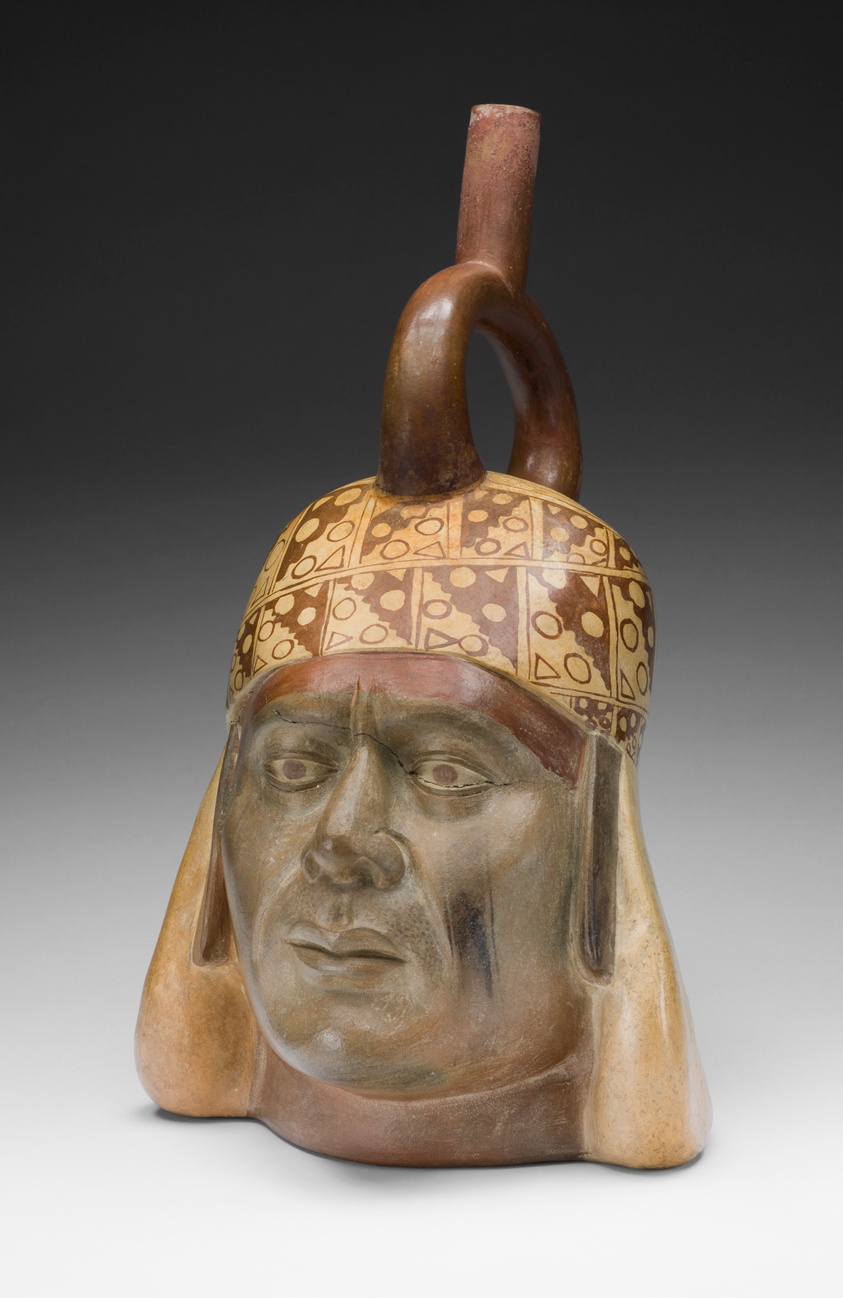
Portrait Vessel
Ceramist unknown (Moche)LinkedCulture matchlcp-bd1bf4c02d5e
- Date
- 600–700
- Medium
- Earthenware and mineral slips
- Culture
- Peruvian North Coast
- Department
- Arts of the Americas
- Institution
- Art Institute of Chicago
- Object ID
- 91620
From the Art Institute of Chicago record
Among the most distinctive art objects of the ancient Peruvians were ceramic vessels produced by the artists of the Moche culture, which flourished on the north coast between about 100 BC and AD 500. Remarkable for their sculptural naturalism, these stirrup-spout bottles were molded without the aid of a potter’s wheel and painted in earth tones. Moche potters represented everything about their world, from domestic scenes to architecture, ritual events and royal personages, and animals and plants. This portrait vessel portrays individual characteristics—the furrowed brow and full, slightly protruding upper lip—as well as general features recognizable among Peruvian Indians today. With his commanding expression and proud bearing, the depicted ruler conveys an indelible sense of the power of Moche leaders. His elite status is further indicated by his fine headdress, decorated with the geometric motifs of Moche textiles, and by his elongated ear ornaments and the traces of facial paint on his forehead and cheeks. Vessels such as this were placed in burials as funerary offerings, but before they accompanied an individual to the grave, they may also have been sent as emblems of royal authority from a center of power to neighboring districts along with gifts of textiles and other ceremonial presents.
The authoritative record is held by Art Institute of Chicago. LinkedCulture surfaces this object and its connections; it does not alter institutional metadata.
Get printable QR codesHide QR codes
Open QR codes for this object page and the museum record. They stay collapsed until needed.
Provenance & credit
As published by the source institution. Coverage varies — not every institution's open-data feed includes ownership history.
- Credit line
- Kate S. Buckingham Endowment Fund
- Provenance
- Eduard Gaffron (1861–1931), Lima, Peru, from 1892 to 1912, then Berlin, from 1912 [History of the Department report (Joanne Behrens, 1985) and correspondence in curatorial file]; by descent to his children Mercedes Gaffron (1908–1993), Berlin then Durham, NC, and Hans Gaffron (1902–1979), Berlin then Chicago [correspondence and documentation of the Gaffron Collection in curatorial file]; sold to the Art Institute of Chicago, 1955.
Linked open data
Authority identifiers that link this record into the wider web of cultural data — stable references you can follow to the source.
- Object type
- AAT300386308
Related across collections
Semantically similar works from Art Institute of Chicago and other institutions.