Art Institute of Chicago
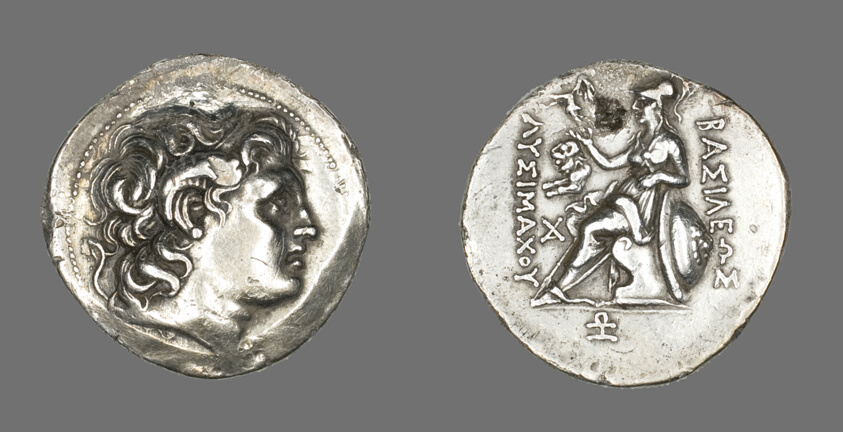
Tetradrachm (Coin) Portraying Alexander the Great
Greek; ThraceLinkedCulture matchlcp-424d0333c970
- Date
- 297-281 BCE, issued by King Lysimachus of Thrace (306–281 BCE)
- Medium
- Silver
- Culture
- Thrace
- Department
- Arts of Greece, Rome, and Byzantium
- Institution
- Art Institute of Chicago
- Object ID
- 9755
From the Art Institute of Chicago record
The Hellenistic period spans the nearly three hundred years between the death of Alexander the Great of Macedonia (323 BCE) and that of Cleopatra VII of Egypt (30 BCE), a descendant of one of Alexander’s generals. The term Hellenistic is derived from Hellas, an ancient Greek word for Greece. It is used to describe both chronologically and culturally the era following Alexander’s conquest of Egypt and Asia, which resulted in the spread of Greek culture across a vast area. The melding of local and Greek artistic styles with the luxurious materials captured in the conquered lands resulted in magnificent artwork, including elegant coinage. Following Alexander’s death, his empire was divided among his generals, who established independent kingdoms in Egypt; Persia; the eastern coast of the Aegean Sea, including Syria and Palestine; Greece and Macedonia; and Thrace. Almost immediately the generals began to covet each other’s land and power. Lysimachus (reigned 323–281 BCE), the general who succeeded Alexander as the ruler of Thrace, used the young ruler’s portrait on the front of this coin. However, on the back Lysimachus named himself “king” and pictured the goddesses Athena and Nike (Victory) crowning his name with laurels, which symbolized victory or honor. He also placed his personal badge—a lion’s fore-parts—under Athena’s hand. The badge referred to Lysimachus’s famous exploit of killing a lion with his bare hands, and reinforced his association with Alexander, who used the skin of the Nemean lion as one of his symbols of power and courage.
The authoritative record is held by Art Institute of Chicago. LinkedCulture surfaces this object and its connections; it does not alter institutional metadata.
Get printable QR codesHide QR codes
Open QR codes for this object page and the museum record. They stay collapsed until needed.
Provenance & credit
As published by the source institution. Coverage varies — not every institution's open-data feed includes ownership history.
- Credit line
- Gift of Mrs. William Nelson Pelouze
- Provenance
- Mrs. William Nelson (Helen T.) Pelouze (1866-1953), Chicago; given to the Art Institute of Chicago, 1923.
Linked open data
Authority identifiers that link this record into the wider web of cultural data — stable references you can follow to the source.
- Object type
- AAT300037334
Related across collections
Semantically similar works from Art Institute of Chicago and other institutions.