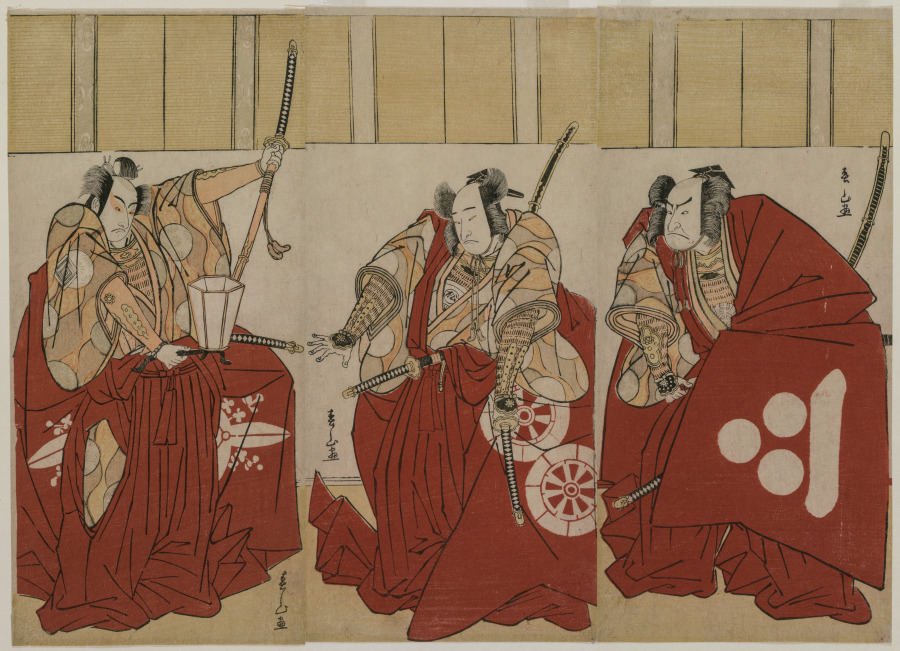
Ichikawa Monnosuke II as Urabe Suetake, Onoe Matsusuke I as Usui Sadamitsu, and Nakamura Nakazo I as Watanabe no Tsuna in “The Four Heavenly Kings Costumed as the Night Watch”

Cleveland Museum of Art

Ichikawa Monnosuke II as Urabe Suetake, Onoe Matsusuke I as Usui Sadamitsu, and Nakamura Nakazo I as Watanabe no Tsuna in “The Four Heavenly Kings Costumed as the Night Watch”

Katsukawa Shunzan

Date
1781
Medium
triptych of color woodblock prints
Culture
Japan, Edo period (1615–1868)
Department
Japanese Art
Institution
Cleveland Museum of Art

This triptych (a composition of three prints) shows actors portraying three of the four famed protectors of imperial regent Minamoto Yorimitsu (948?–1021). Collectively, they are known as his Shitennō (四天王), or “Four Heavenly Kings,” after the Buddhist deities who guard the four cardinal directions. The characters are indicated by the large house crests on their robes. The actor Onoe Matsusuke I’s identity is revealed by a fan with the ideograph matsu (松), or “pine,” tucked into his robe, just against his breastplate.

The authoritative record is held by Cleveland Museum of Art. LinkedCulture surfaces this object and its connections; it does not alter institutional metadata.

LinkedCulture video

Ichikawa Monnosuke II as Urabe Suetake, Onoe Matsusuke I as Usui Sadamitsu, and Nakamura Nakazo I as Watanabe no Tsuna in “The Four Heavenly Kings Costumed as the Night Watch”

Jun 18, 2026 · Short

Follow LinkedCultureYouTubeInstagram
Museum record

Related across collections

Semantically similar works from Cleveland Museum of Art and other institutions.

Ichikawa Monnosuke II as Urabe no Suetake

Ichikawa Monnosuke II as Urabe no Suetake

Cleveland Museum of Art

The Actors Segawa Kikunojo III as the Spirit of Joro-gumo (Harlot Spider) Disguised as the Maiko Tsumagiku (right), and Ichikawa Monnosuke II as Urabe no Suetake (left), in the Play Shitenno Tonoi no Kisewata, Performed at the Nakamura Theater in the Eleventh Month, 1781

The Actors Segawa Kikunojo III as the Spirit of Joro-gumo (Harlot Spider) Disguised as the Maiko Tsumagiku (right), and Ichikawa Monnosuke II as Urabe no Suetake (left), in the Play Shitenno Tonoi no Kisewata, Performed at the Nakamura Theater in the Eleventh Month, 1781

Art Institute of Chicago

Onoe Matsusuke as Usui Sadamitsu

Onoe Matsusuke as Usui Sadamitsu

Cleveland Museum of Art

Nakamura Nakazo I as Watanabe no Tsuna

Nakamura Nakazo I as Watanabe no Tsuna

Cleveland Museum of Art

The Actor Ichikawa Danjuro V as Sakata Hyogonosuke Kintoki, in the Play Shitenno Tonoi no Kisewata (Raiko's Four Intrepid Retainers in the Costume of the Night Watch), Performed at the Nakamura Theater from the First Day of the Eleventh Month, 1781

The Actor Ichikawa Danjuro V as Sakata Hyogonosuke Kintoki, in the Play Shitenno Tonoi no Kisewata (Raiko's Four Intrepid Retainers in the Costume of the Night Watch), Performed at the Nakamura Theater from the First Day of the Eleventh Month, 1781

Art Institute of Chicago

Actors Ichimura Uzaemon IX as Kajiwara Genta no Kagetoki (Left), Segawa Kikunojô II as Yuki Onna (Center), and Arashi Sangorô II as Minamoto no Yoritomo (Right) in “Cotton Wadding of Izu Protecting the Matrimonial Chrysanthemums” (“Miyoto-giku Izu no kisewata”)

Actors Ichimura Uzaemon IX as Kajiwara Genta no Kagetoki (Left), Segawa Kikunojô II as Yuki Onna (Center), and Arashi Sangorô II as Minamoto no Yoritomo (Right) in “Cotton Wadding of Izu Protecting the Matrimonial Chrysanthemums” (“Miyoto-giku Izu no kisewata”)

Art Institute of Chicago

Ichikawa Monnosuke II as Shimokōbe Shōji Yukihira and Segawa Yūjiro I as Matsukaze, Sister of Togashi no Saemon, in “Your Favorite Play: The Subscription List” (Gohiiki Kanjinchō)

Ichikawa Monnosuke II as Shimokōbe Shōji Yukihira and Segawa Yūjiro I as Matsukaze, Sister of Togashi no Saemon, in “Your Favorite Play: The Subscription List” (Gohiiki Kanjinchō)

Art Institute of Chicago

Actors Ichikawa Monnosuke II (right), Iwai Hanshirō IV (center), and Onoe Matsusuke I (left)

Actors Ichikawa Monnosuke II (right), Iwai Hanshirō IV (center), and Onoe Matsusuke I (left)

Harvard Art Museums

Ichikawa Monnosuke II as Shimokōbe Shōji Yukihira and Segawa Yūjiro I as Matsukaze, Sister of Togashi no Saemon, in “Your Favorite Play: The Subscription List” (Gohiiki Kanjinchō)

Ichikawa Monnosuke II as Shimokōbe Shōji Yukihira and Segawa Yūjiro I as Matsukaze, Sister of Togashi no Saemon, in “Your Favorite Play: The Subscription List” (Gohiiki Kanjinchō)

Art Institute of Chicago

Actor Ichikawa Danjūrō V as the Monk Wantetsu

Actor Ichikawa Danjūrō V as the Monk Wantetsu

Minneapolis Institute of Art

The Actors Sawamura Sojuro III as Kusunoki Tatewaki Masatsura (right), Onoe Matsusuke I as the Monk Sahei Bozu (center) and Ichikawa Yaozo III as the Prince's Servant Kusunoki Uraminosuke (left), in the Play Kumoi no Hana Yoshino no Wakamusha, Performed at the Nakamura Theater in the Eleventh Month, 1786

The Actors Sawamura Sojuro III as Kusunoki Tatewaki Masatsura (right), Onoe Matsusuke I as the Monk Sahei Bozu (center) and Ichikawa Yaozo III as the Prince's Servant Kusunoki Uraminosuke (left), in the Play Kumoi no Hana Yoshino no Wakamusha, Performed at the Nakamura Theater in the Eleventh Month, 1786

Art Institute of Chicago

The Actors Sawamura Kijuro I as Ikazuchi Shinno, Prince of Thunder (far left), Ichikawa Danjuro V as the Buddhist Deity Fudo (second from left), Nakamura Sukegoro II as Seitaka Doji (second from right), and Bando Mitsugoro I as Kongara Doji (far right), in the Play Fuki Kaete Tsuki mo Yoshiwara (Rethatched Roof: The Moon also Shines Over the Yoshiwara Pleasure District), Performed at the Morita Theater in the Eleventh Month, 1771

The Actors Sawamura Kijuro I as Ikazuchi Shinno, Prince of Thunder (far left), Ichikawa Danjuro V as the Buddhist Deity Fudo (second from left), Nakamura Sukegoro II as Seitaka Doji (second from right), and Bando Mitsugoro I as Kongara Doji (far right), in the Play Fuki Kaete Tsuki mo Yoshiwara (Rethatched Roof: The Moon also Shines Over the Yoshiwara Pleasure District), Performed at the Morita Theater in the Eleventh Month, 1771

Art Institute of Chicago