Cleveland Museum of Art
Tarocchi
Master of the E-Series TarocchiLinkedCulture matchlcp-0e90d5e870aa
- Date
- before 1467
- Medium
- engraving hand-colored with gold
- Culture
- Italy, Ferrara, 15th century
- Department
- Prints
- Institution
- Cleveland Museum of Art
- Object ID
- 106350
What the image shows
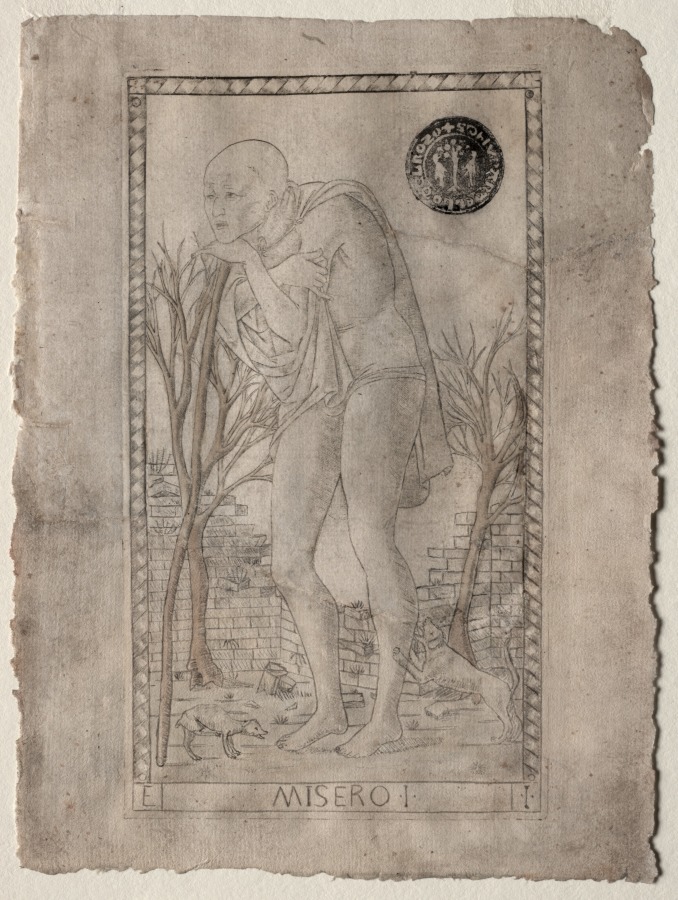
A figure in a draped garment leans against a tree, holding a staff, with a small animal nearby.
Generated by LinkedCulture from the photograph alone, without the museum’s catalogue text (Qwen/Qwen2.5-VL-7B-Instruct), and not yet reviewed by a person. It describes the picture, not the object’s history, and it is not part of the museum’s record.
From the Cleveland Museum of Art record
Scholars generally agree that this set of 50 engravings was an educational tool, perhaps devised by a humanist scholar to visually describe a fifteenth-century philosophical model of the cosmos. It was believed that the universe was a ladder-like structure that began with the beggar and rose through the ranks of humankind, the muses, the liberal arts, the virtues, and the planets, until it finally reached the pinnacle, the dwelling place of God. Reflecting this order, the engravings can be divided into five groups distinguished by the letters E, D, C, B, A, respectively marking the Conditions of Man (five serfs and five aristocrats); Apollo and the nine Muses; the seven Liberal Arts (with three added disciplines—Poetry, Philosophy, and Theology); the seven Virtues (with three personifications of cosmic principles called "Genii"); and the Firmaments of the Universe (eight cosmic spheres and two prime movers— Primo Mobile and Prima Causa ). Each unit in the Tarocchi set is thus structured around the number ten which—according to the Greek Philosopher Aristotle—was a perfect expression of Divine unity. Designed, engraved, and hand-colored in gold by artists and craftsmen in Northern Italy whose names are unknown to us today, the series exists in two versions. The museum's set, known as the "E" series (named for the letter in the lower left corner of the prints in the first group of ten), is believed to be the first version. The Italian word tarocchi (tarot) refers to a gambling game; though once thought to describe the function of this set of engravings, today it is understood to be a misnomer.
The authoritative record is held by Cleveland Museum of Art. LinkedCulture surfaces this object and its connections; it does not alter institutional metadata.
Get printable QR codesHide QR codes
Open QR codes for this object page and the museum record. They stay collapsed until needed.
Provenance & credit
As published by the source institution. Coverage varies — not every institution's open-data feed includes ownership history.
- Credit line
- Dudley P. Allen Fund
Related across collections
Semantically similar works from Cleveland Museum of Art and other institutions.