Cleveland Museum of Art
The Large Passion: The Crucifixion
Albrecht DürerLinkedCulture matchlcp-91cf98b472c5
- Date
- c. 1497–1500
- Medium
- woodcut
- Culture
- Germany
- Department
- Prints
- Institution
- Cleveland Museum of Art
- Object ID
- 108386
From LinkedCulture
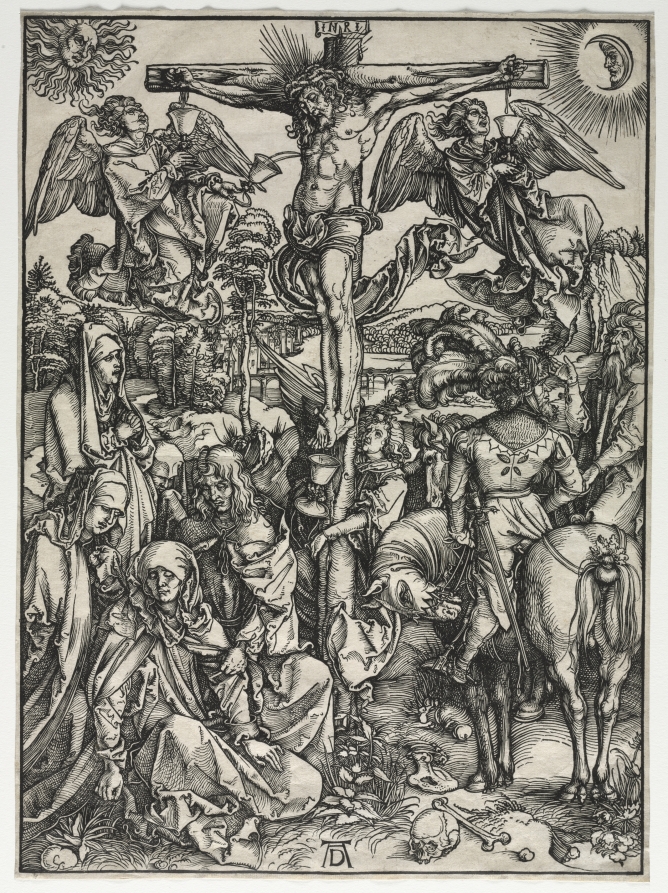
Around 1497, a young Albrecht Dürer carved this large-scale Crucifixion woodcut with a density no printmaker had attempted before. Christ hangs beneath the INRI inscription while angels catch his blood in chalices, the Virgin collapses at lower left, and both sun and moon occupy the upper corners. The thick black lines pressing hard against white paper give it a raw energy that Dürer's own later prints in this same series never quite matched, making this one of the most vital early works in the history of printmaking.
Written by LinkedCulture for its video on this object. Machine-generated (claude-sonnet-4-6), not yet reviewed by a person. It is not part of the museum’s record.
What the image shows
A religious scene depicting the crucifixion of Jesus Christ surrounded by angels, soldiers, and mourners.
Generated by LinkedCulture from the photograph alone, without the museum’s catalogue text (Qwen/Qwen2.5-VL-7B-Instruct), and not yet reviewed by a person. It describes the picture, not the object’s history, and it is not part of the museum’s record.
From the Cleveland Museum of Art record
Dürer made seven of the twelve woodcuts for The Large Passion between 1497 and 1500 and then produced four additional woodcuts in 1510. The following year he published the series in book form with a frontispiece and Latin verses composed by Benedict Schwalbe. The Nuremberg monk and poet's text was printed on the back of the sheets. At the same time, Dürer printed a second edition of The Apocalypse and the first edition of The Life of the Virgin . The scenes of The Large Passion executed between 1497 and 1500 retain certain Gothic conventions: a wealth of detail; two-dimensional, awkward figures; ambiguous picture space; and confusing compositions. However, the strong contrast between the thick, black, expressive lines and the white paper creates a vitality lost in the prints from 1510, when Dürer's style changed dramatically. The letters in the banderole above the cross, INRI , are an abbreviation of the Latin phrase Iesus Nazarenus Rex Judaeorum (Jesus of Nazareth the King of the Jews).
The authoritative record is held by Cleveland Museum of Art. LinkedCulture surfaces this object and its connections; it does not alter institutional metadata.
Get printable QR codesHide QR codes
Open QR codes for this object page and the museum record. They stay collapsed until needed.
Provenance & credit
As published by the source institution. Coverage varies — not every institution's open-data feed includes ownership history.
- Credit line
- Gift of The Print Club of Cleveland in memory of Ralph King
- Provenance
- ?-1926: (M. Knoedler & Co., Inc., New York, NY) | June 4, 1926: The Cleveland Museum of Art, Cleveland, OH
Related across collections
Semantically similar works from Cleveland Museum of Art and other institutions.