Cleveland Museum of Art
Nymphs and a Satyr (Amor Vincit Omnia)
Nicolas PoussinLinkedCulture matchlcp-7354b59d2923
- Date
- c. 1625–27
- Medium
- oil on canvas
- Culture
- France, 17th century
- Department
- European Painting and Sculpture
- Institution
- Cleveland Museum of Art
- Object ID
- 108555
From the Cleveland Museum of Art record
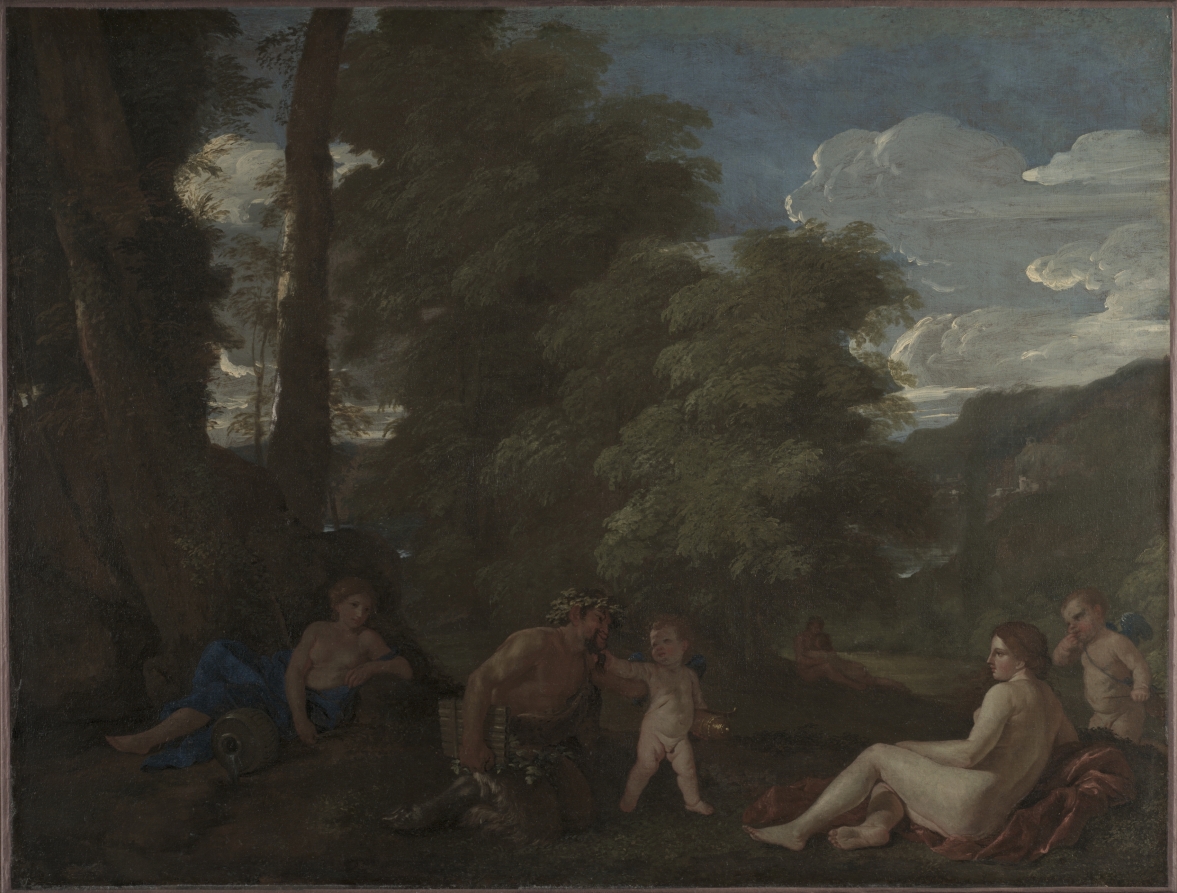
Like his colleague Claude Lorrain, Poussin depicted historical and mythological subjects in landscapes inspired by the countryside around Rome. His themes were often complex, and frequently incorporated witty allusions to classical texts. Here, a playful cupid tugs Pan, the goatlegged Greek god of the woods, toward Venus, the goddess of love. The painting cleverly illustrates the Latin phrase amor vincit omnia, or “love conquers all” (in Greek, pan means “all”). The woodland setting represents the idyllic paradise of Pan’s home. After arriving in Rome and experiencing financial instability, Nicolas Poussin turned to painting more popular, lucrative mythological scenes, such as those depicting nymphs and satyrs.
The authoritative record is held by Cleveland Museum of Art. LinkedCulture surfaces this object and its connections; it does not alter institutional metadata.
Get printable QR codesHide QR codes
Open QR codes for this object page and the museum record. They stay collapsed until needed.
Provenance & credit
As published by the source institution. Coverage varies — not every institution's open-data feed includes ownership history.
- Credit line
- Gift of J. H. Wade
- Provenance
- Cassiano dal Pozzo (Rome, Italy) to Gabriele dal Pozzo (1695, 1740) | Lord Radstock, sold, Christie's, London, May 13, 1826, lot 27) | Private collection, sold Phillips, London, 1829) | Lord Northwick, Thirlestane House, near Cheltenham, by 1837, sold, Phillips, London, August 24, 1859, lot 1809) | J. S. W.S. Erle Drax, Esq., Olantigh Towers, Wye, Kent, sold Christie's,London, February 19 and 21, 1910, lot 105, to Cohen | Cohen | David Horner, London, by 1925 | Durlacher Brothers (London, England), sold to the Cleveland Museum of Art, 1926.
Related across collections
Semantically similar works from Cleveland Museum of Art and other institutions.