Cleveland Museum of Art
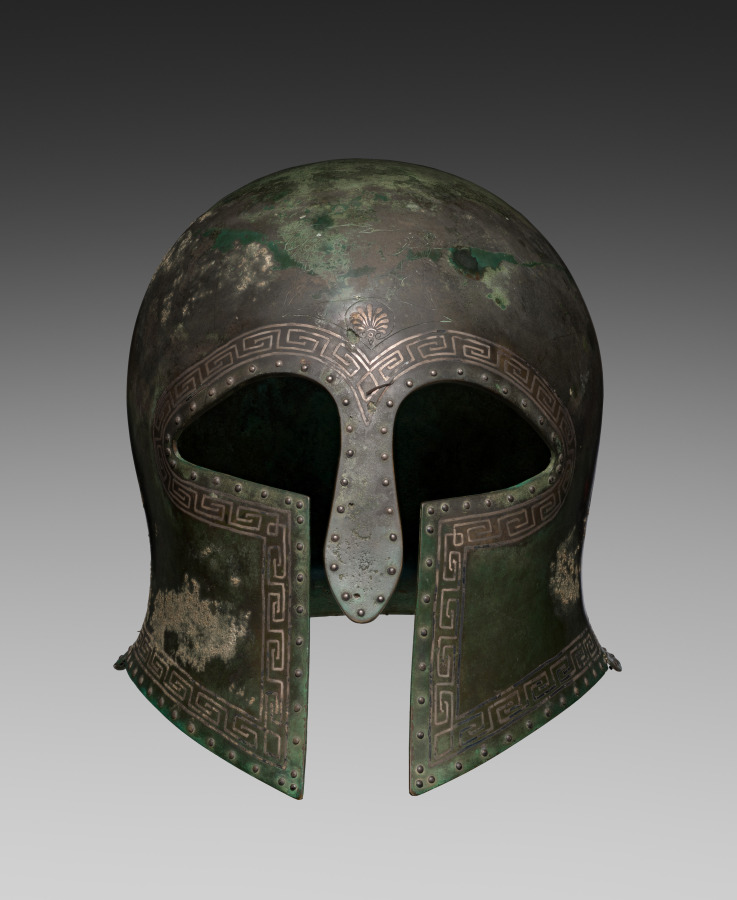
Corinthian Helmet
- Date
- 500–475 BCE or modern (before 1926)
- Medium
- bronze with silver inlay
- Culture
- Greece
- Department
- Greek and Roman Art
- Institution
- Cleveland Museum of Art
- Object ID
- 108870
From the Cleveland Museum of Art record
Probably cast and then hammered into shape, this bronze helmet belongs to a type known as Corinthian, with almond-shaped eye holes, large cheekpieces, and a wide nose guard. Its significant weight raised early suspicions about authenticity, and although a 1928 technical examination found no conclusive evidence of forgery, scholars have continued to doubt its antiquity. Unusual details include the intact rivets, or metal fasteners, meant to secure liners; usually only their holes survive. The dueling warriors and inlaid palmette above the brow also find few parallels, and the silver meander pattern is unique. Most recently, a 2024 analysis found that both the copper and silver alloys of the helmet differ significantly from those expected in an ancient Greek helmet. This helmet is very heavy—2.56 kilograms (5 lbs., 10 oz.), compared to average ancient helmets of 1.2–1.6 kilograms (about 3 lbs.).
The authoritative record is held by Cleveland Museum of Art. LinkedCulture surfaces this object and its connections; it does not alter institutional metadata.
Get printable QR codesHide QR codes
Open QR codes for this object page and the museum record. They stay collapsed until needed.
Provenance & credit
As published by the source institution. Coverage varies — not every institution's open-data feed includes ownership history.
- Credit line
- Gift of J. H. Wade
- Provenance
- (Bruno Tartaglia through Howard W. Parsons)
Part of a LinkedCulture topic
 European Renaissance Armor Components
These objects are all pieces of defensive armor and military equipment from 15th-17th century Europe, primarily from major armoring centers like Italy, Germany, and France.
500 objects from 4 institutions
Related across collections
Semantically similar works from Cleveland Museum of Art and other institutions.