Cleveland Museum of Art
Sarcophagus
- Date
- c. 100–125 CE
- Medium
- Greek marble
- Culture
- Italy, Rome, Roman Empire
- Department
- Greek and Roman Art
- Institution
- Cleveland Museum of Art
- Object ID
- 110233
From the Cleveland Museum of Art record
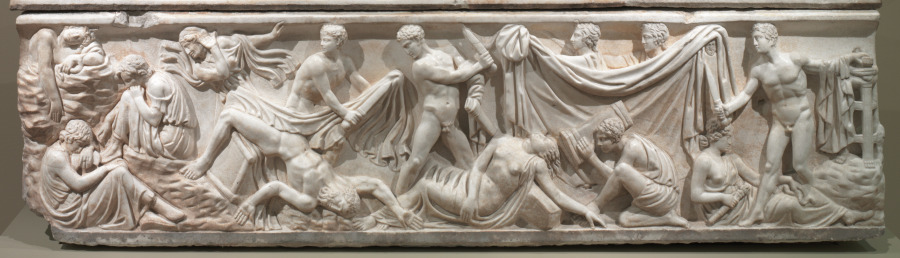
The tragic figure Orestes appears three times on the front of this sarcophagus, always wielding a short sword. In the center he stands over the body of his mother Clytemnestra, and at center left over the body of her lover Aegisthus. Orestes has killed them both to avenge their murder of his father Agamemnon, upon his return from years of fighting at Troy. At the far left, three Furies (avenging spirits) rest upon Agamemnon's tomb, while at the far right, Orestes atones for the murders at the Delphian shrine of Apollo, marked by a tripod and rock. On the lid, four reclining women symbolize the seasons, arranged in right-to-left order: Winter, Spring, Summer, Autumn, as indicated by their dress and the contents of their baskets. From the Greek word for “flesh-eating,” sarcophagus is now used generically for “coffin.”
The authoritative record is held by Cleveland Museum of Art. LinkedCulture surfaces this object and its connections; it does not alter institutional metadata.
Get printable QR codesHide QR codes
Open QR codes for this object page and the museum record. They stay collapsed until needed.
Provenance & credit
As published by the source institution. Coverage varies — not every institution's open-data feed includes ownership history.
- Credit line
- Gift of the John Huntington Art and Polytechnic Trust
Related across collections
Semantically similar works from Cleveland Museum of Art and other institutions.