Cleveland Museum of Art
Arm Reliquary of the Apostles
- Date
- c. 1190
- Medium
- gilt silver, champlevé enamel, oak
- Culture
- Germany, Lower Saxony, Hildesheim, Romanesque period, late 12th century
- Department
- Medieval Art
- Institution
- Cleveland Museum of Art
- Object ID
- 112316
From the Cleveland Museum of Art record
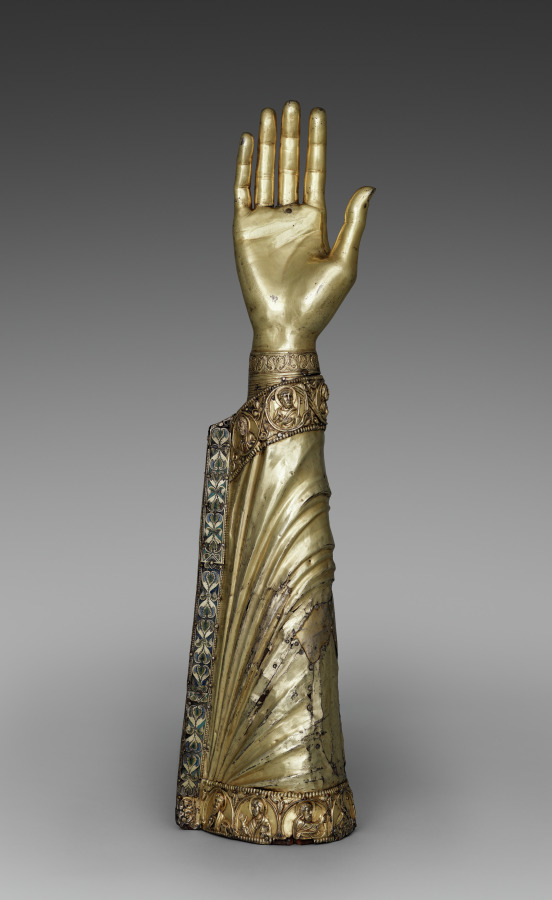
Taking the form of a clothed lower arm with an outstretched hand, this reliquary from the Guelph Treasure appropriately enshrines a piece of an unidentified saint’s arm bone. Arm reliquaries like this one served as liturgical props; during religious services and processions, the clergy used them to bless and touch the faithful, thus making the presence of the saint more palpable and immediate. The apostle busts that decorate this arm reliquary seem to indicate that the relic it contains is that of an apostle. Duke Henry the Lion, a major patron of the church of Saint Blaise, is known to have received such relics from the Byzantine emperor Manuel I (1143-1180) upon his return from a pilgrimage to Jerusalem. Reliquaries were prized not for the opulence that you see, but for the items that they held. They enshrined items associated with saints, like a piece of clothing they wore or a small portion of their remains. In this case, an arm bone is encased within.
The authoritative record is held by Cleveland Museum of Art. LinkedCulture surfaces this object and its connections; it does not alter institutional metadata.
Get printable QR codesHide QR codes
Open QR codes for this object page and the museum record. They stay collapsed until needed.
Provenance & credit
As published by the source institution. Coverage varies — not every institution's open-data feed includes ownership history.
- Credit line
- Gift of the John Huntington Art and Polytechnic Trust
- Provenance
- Monastery of St. Cyriakus, Brunswick | Treasury, Cathedral of St. Blaise, Brunswick | House of Brunswick-Lüneburg (part of Guelph Treasure) | ?-1930: (Goldschmidt Galleries, New York, NY, sold to the Cleveland Museum of Art) | 1930-: The Cleveland Museum of Art, Cleveland, OH
Related across collections
Semantically similar works from Cleveland Museum of Art and other institutions.