Cleveland Museum of Art
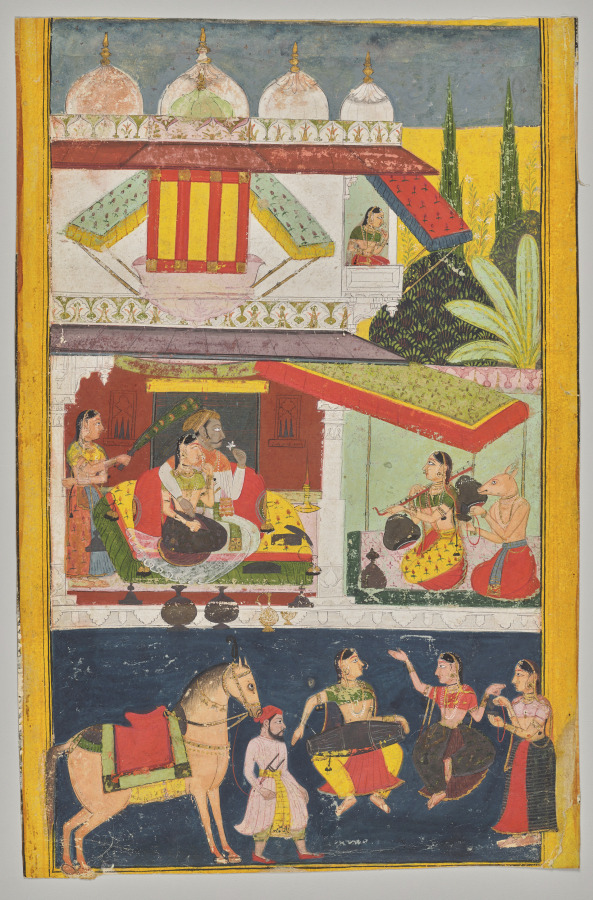
Shri Raga, from a Ragamala
- Date
- c. 1695
- Medium
- Gum tempera and gold on paper
- Culture
- Northwestern India, Rajasthan, Rajput Kingdom of Mewar
- Department
- Indian and Southeast Asian Art
- Institution
- Cleveland Museum of Art
- Object ID
- 112858
From the Cleveland Museum of Art record
This painting is from an important series made at a turning point in the history of court painting at the Rajput kingdom of Mewar. For the first time, a royal patron, Amar Singh II (r. 1698–1710), even before his accession to the throne, decided to incorporate Mughal elements into secular art, as seen in the white domed architecture and interest in conveying some sense of spatial depth. Nevertheless, the artist still adheres to the use of horizontal registers and bold planes of color. The codified iconography of Shri Raga involves a royal couple listening to recitations. Shri Raga is described as: "Splendidly enthroned of peerless beauty and lovely as the autumn moon, he sits hearing stories from Narada and Tumburu. By the great sages he is called Shri Raga King." Amar Singh has playfully substituted his own portrait for that of the generic king, and a woman for that of the sage. In music, Shri Raga is associated with the season of autumn and the harvest festivals, here evoked by the dancing female musicians in the lower register. The horse-headed musician playing the cymbals is a celestial being (gandharva) famed for his sweet voice.
The authoritative record is held by Cleveland Museum of Art. LinkedCulture surfaces this object and its connections; it does not alter institutional metadata.
Get printable QR codesHide QR codes
Open QR codes for this object page and the museum record. They stay collapsed until needed.
Provenance & credit
As published by the source institution. Coverage varies — not every institution's open-data feed includes ownership history.
- Credit line
- Edward L. Whittemore Fund
- Provenance
- ?–1931: Ananda K. Coomaraswamy [1877–1947] sold to the Cleveland Museum of Art | 1931–: The Cleveland Museum of Art, Cleveland, OH
Related across collections
Semantically similar works from Cleveland Museum of Art and other institutions.