Cleveland Museum of Art
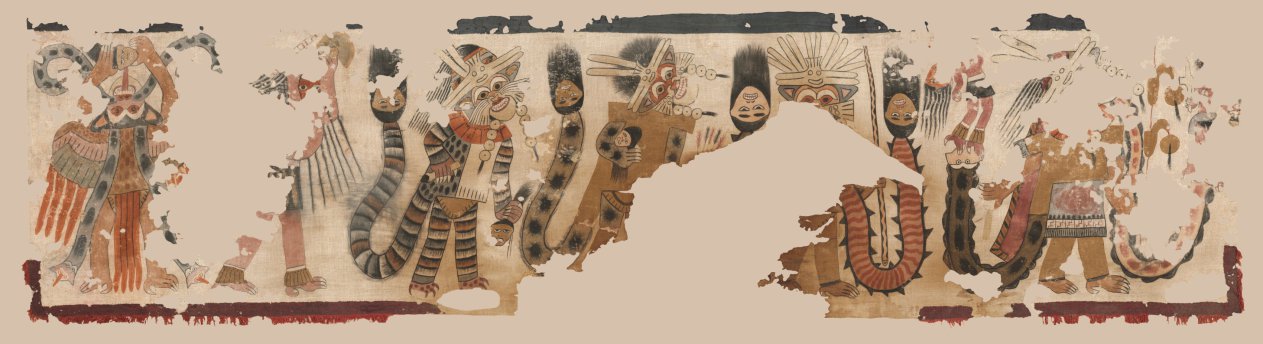
Cloth with Procession of Figures
- Date
- 170 BCE–70 CE (radiocarbon date, 95% probability)
- Medium
- cotton and pigment (field); camelid fiber (borders and fringe)
- Culture
- Central Andes, South Coast, Nasca people
- Department
- Textiles
- Institution
- Cleveland Museum of Art
- Object ID
- 119693
From the Cleveland Museum of Art record
Experts agree that this cloth is one of the greatest paintings to survive from Andean antiquity due to the realism, complexity, large size, and refined execution of its figures. All but one of the figures wear the whiskered mouth mask of Nasca supernatural beings and several carry or wear severed human heads, which the Nasca linked to nature’s fruitfulness. Thus, the figures seem to represent supernatural forces or humans personifying such forces during a ritual devoted to agricultural fertility. Originally, the panel was attached along its upper edge to a dark blue cloth of equal size. The complete textile may have served as a mantle (a shawl-like garment), a hanging, or a funerary offering. Characteristics of the pampas cat and the emperor tamarin monkey are visible in the marching figures.
The authoritative record is held by Cleveland Museum of Art. LinkedCulture surfaces this object and its connections; it does not alter institutional metadata.
Get printable QR codesHide QR codes
Open QR codes for this object page and the museum record. They stay collapsed until needed.
Provenance & credit
As published by the source institution. Coverage varies — not every institution's open-data feed includes ownership history.
- Credit line
- The Norweb Collection
- Provenance
- ?-1940: Emery May Holden Norweb (1895-1984) and Raymond Henry Norweb (1894-1983), Cleveland OH, given to the Cleveland Museum of Art | 1940-: The Cleveland Museum of Art, Cleveland, OH
Related across collections
Semantically similar works from Cleveland Museum of Art and other institutions.