Cleveland Museum of Art
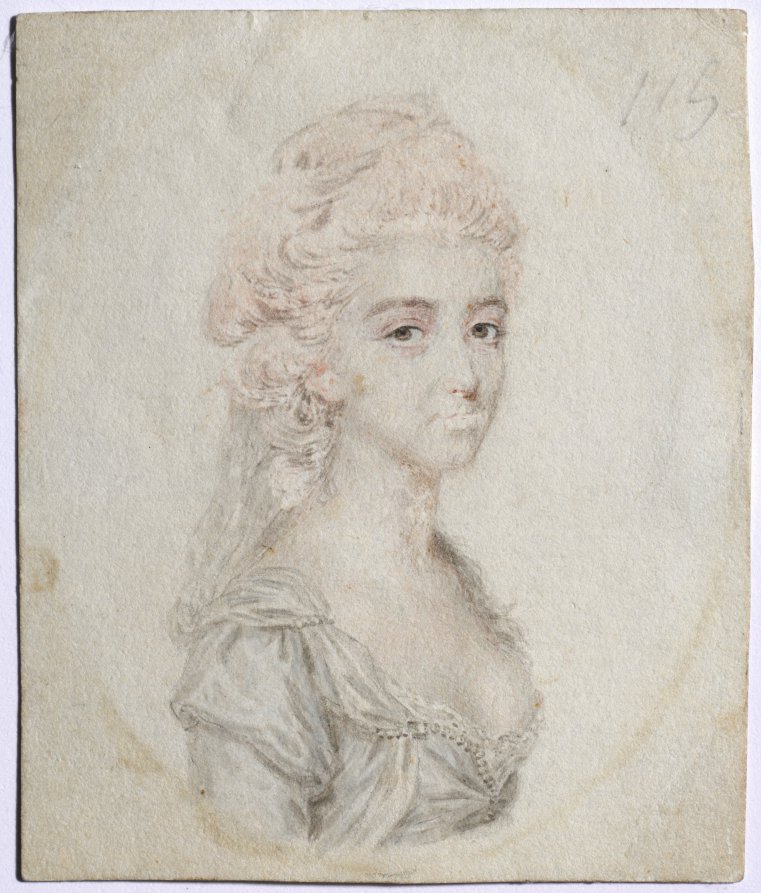
Portrait of a Woman
John I SmartLinkedCulture matchlcp-678a8aa663ce
- Date
- c. 1776
- Medium
- graphite and wash on laid paper
- Culture
- England, 18th century
- Department
- Drawings
- Institution
- Cleveland Museum of Art
- Object ID
- 120842
From the Cleveland Museum of Art record
Although it is impossible to say if it was always part of the artist’s process to execute a preparatory sketch prior to painting each miniature, we do know that John Smart retained many hundreds of these sketches. A group of preparatory sketches—of which this portrait is one—descended through the Smirke family after Smart’s daughter Sarah gave a sketchbook containing preparatory portrait studies to her friend Mary Smirke, sister of the celebrated Victorian architect Sydney Smirke. This book was probably broken up around 1877 when it was divided between Sydney’s daughters Mary Jemmett and Mrs. Lange, whose portions were both sold at auction in 1928. Compared to his contemporaries George Engleheart (1752–1829) and Andrew Plimer (1763–1837), whose female sitters were often painted in similar simple white gowns, Smart often lavished more attention on the costumes in his portraits of women, whose dresses incorporated colored silks, printed fabrics, and luxury trimmings like lace and fur. The sitter’s head and shoulders face left. She has what was probably once blond hair—now faded to pink—dressed high on her head, with curls down the back of her neck, over which a veil descends. Her eyes are hazel, and the color of her lips has almost completely faded. Positioned in an oval, and revealing much of her left breast, she wears a low-necked dress with faint traces of pink pigment, trimmed with a string of pearls. The background is unpainted. To this date, the finished ivory for which this preparatory sketch was presumably undertaken has not been discovered. The portrait was assigned the historically colorful but fictitious title of “Henrietta Maria” at some point after memory of its true identity had been lost. Giving illustrious titles to portraits of unknown sitters was a popular strategy adopted by dealers during the nineteenth and twentieth centuries, often applied to miniature portraits and, in particular, to Smart’s sketches of women. In 1948 Arthur Jaffé wrote to the Cleveland Museum of Art that a “Mrs. Samuelson of Exeter recently brought me two frames, with six sketches mounted in each, of ladies, mostly with fancy names. I think there is no doubt that they were part of Mrs. Lange’s share of the Smirke sketches, though unlike yours they did not pass through Christie’s auction in Dec. 1928. I persuaded Mrs. Samuelson to let me remove them from their frames and to rub the paper backing from the card on which the sketches are painted. The result was as follows. Included was a No. 115 called, Margaret, Archduchess of Austria, which is the same number given to our Henrietta Maria.” Elsewhere Jaffé notes that the number on the front of this sketch was probably a 119 instead of a 115. Sketches helped John Smart work out the particulars of a portrait before commencing the miniature on ivory; they were useful in the event that a duplicate might later be required.
The authoritative record is held by Cleveland Museum of Art. LinkedCulture surfaces this object and its connections; it does not alter institutional metadata.
Get printable QR codesHide QR codes
Open QR codes for this object page and the museum record. They stay collapsed until needed.
Provenance & credit
As published by the source institution. Coverage varies — not every institution's open-data feed includes ownership history.
- Credit line
- The Edward B. Greene Collection
- Provenance
- c. 1776-1811: John Smart (1741-1811), by in heritance to his daughter by Sarah Midgeley, Sarah Smart | 1811-c. 1853: Sarah Smart (1781-1853), gifted to Mary Smirke | c. 1853: Mary Smirke (d. 1853, Slough), by inheritance to her brother, Sydney Smirke | 1853-77: Sydney Smirke (1798-1877) by inheritance to his daughter, Mrs. Lange | 1877-1928: Mrs. Lange (née Smirke, d. 1928), by inheritance to her brother, Sir Edward Smirke | -1928: Sir Edward Smirke | December 10, 1928: Sale: Christie’s, London, December 10, 1928 (lot 2). | 1928-1929: Leo Schidlof (1886-1966), Paris, France, sold to Edward B. Greene | 1929-1941: Edward B. Greene (1878-1957), Cleveland, OH gifted to the Cleveland Museum of Art | 1941-: The Cleveland Museum of Art, Cleveland, OH
Part of a LinkedCulture topic
 English Portrait Miniatures
A collection of portrait miniatures from 17th-18th century England, predominantly featuring watercolor on ivory or graphite and wash techniques, representing the tradition of intimate personal portraiture in miniature fo
221 objects from 4 institutions
Related across collections
Semantically similar works from Cleveland Museum of Art and other institutions.