Cleveland Museum of Art
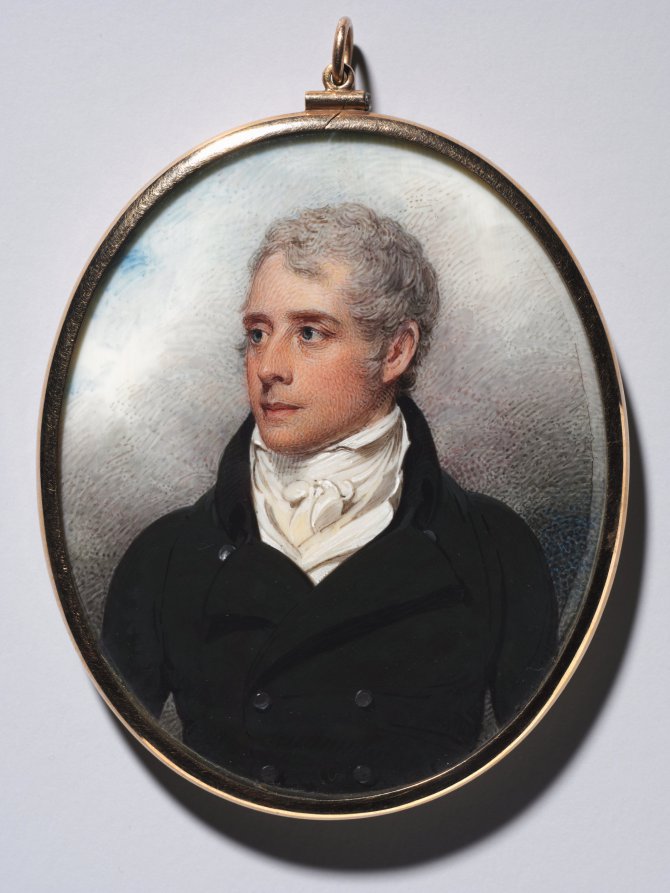
Portrait of Sandford Peacocke
William WoodLinkedCulture matchlcp-dd9ac5054272
- Date
- 1801
- Medium
- watercolor on ivory in a gold frame with glazed reverse
- Culture
- England, early 19th century
- Department
- Modern European Painting and Sculpture
- Institution
- Cleveland Museum of Art
- Object ID
- 121288
From the Cleveland Museum of Art record
William Wood worked primarily in London and exhibited over 100 miniatures at the Royal Academy, where he began his training at the age of 16. His portraits of men in particular are regarded as highly refined and remarkably sensitive psychological studies. While Wood is known to have copied miniatures by Richard Cosway (1742–1821), George Engleheart (1752–1829), and John Smart (1741–1811), his distinctive style can be observed in the network of small dots and dashes of paint that follow the contours of a sitter’s face. In addition to portrait miniatures, Wood executed a number of eye miniatures and became increasingly interested in watercolor landscapes during the years preceding his death in 1810. He signed his miniatures on the paper backing, often with the sitter’s name or initials, Wood’s studio location, and the year. The fact that the artist signed his work on the back rather than the front has contributed to making his miniatures harder to identify immediately, an issue complicated by his aptitude for imitating a variety of styles employed by his fellow miniaturists. Historians have rare insight into Wood’s working process due to the survival of his four-volume ledger that documents 1,211 miniatures painted by the artist between 1790 and 1808; the ledger is now in the collection of the National Art Library at the Victoria and Albert Museum. The entries are remarkably thorough, frequently including information about when a work was begun and completed, its size, the colors used and their durability, the sitter’s costume, and the price charged. From 1794, Wood also attached tracings of many of the miniatures to the ledger entries. Along with the careful notes he kept, these tracings would have facilitated the making of copies or revisions, which were evidently performed with some frequency when a sitter desired a change in hairstyle or costume; the promotion of an officer necessitated an alteration of his uniform; or a miniature’s pigments proved fugitive. Wood usually used numbers to refer to the colors applied in a work, but no key for them exists, and their identity often remains a mystery. The entry for this portrait is characteristically complete and notes that the sitter was residing at Devonshire Street in London. It contains an attached tracing of the miniature and records that the portrait was begun on March 25, 1801, finished on April 11, and delivered July 29. Wood’s miniatures were often delivered days after they were completed, so it is noteworthy that this work was not relinquished by Wood for more than three months after its completion. Moreover, it was received not by the sitter or a family member but by a “General Stuart,” whose relationship to Peacocke is unknown. Sandford Peacocke was married in 1801 and by 1802 was serving in the British military in Jamaica. It may have been for these occasions that the miniature was painted.
The authoritative record is held by Cleveland Museum of Art. LinkedCulture surfaces this object and its connections; it does not alter institutional metadata.
Get printable QR codesHide QR codes
Open QR codes for this object page and the museum record. They stay collapsed until needed.
Provenance & credit
As published by the source institution. Coverage varies — not every institution's open-data feed includes ownership history.
- Credit line
- The Edward B. Greene Collection
- Provenance
- -1929: (Leo Schidlof (1886-1966), Paris, France, sold to Edward B. Greene) | 1929-1942: Edward B. Greene (1878-1957), Cleveland, OH, gifted to the Cleveland Museum of Art | 1942-: The Cleveland Museum of Art, Cleveland, OH
Part of a LinkedCulture topic
 English Portrait Miniatures
A collection of portrait miniatures from 17th-18th century England, predominantly featuring watercolor on ivory or graphite and wash techniques, representing the tradition of intimate personal portraiture in miniature fo
221 objects from 4 institutions
Related across collections
Semantically similar works from Cleveland Museum of Art and other institutions.