Cleveland Museum of Art
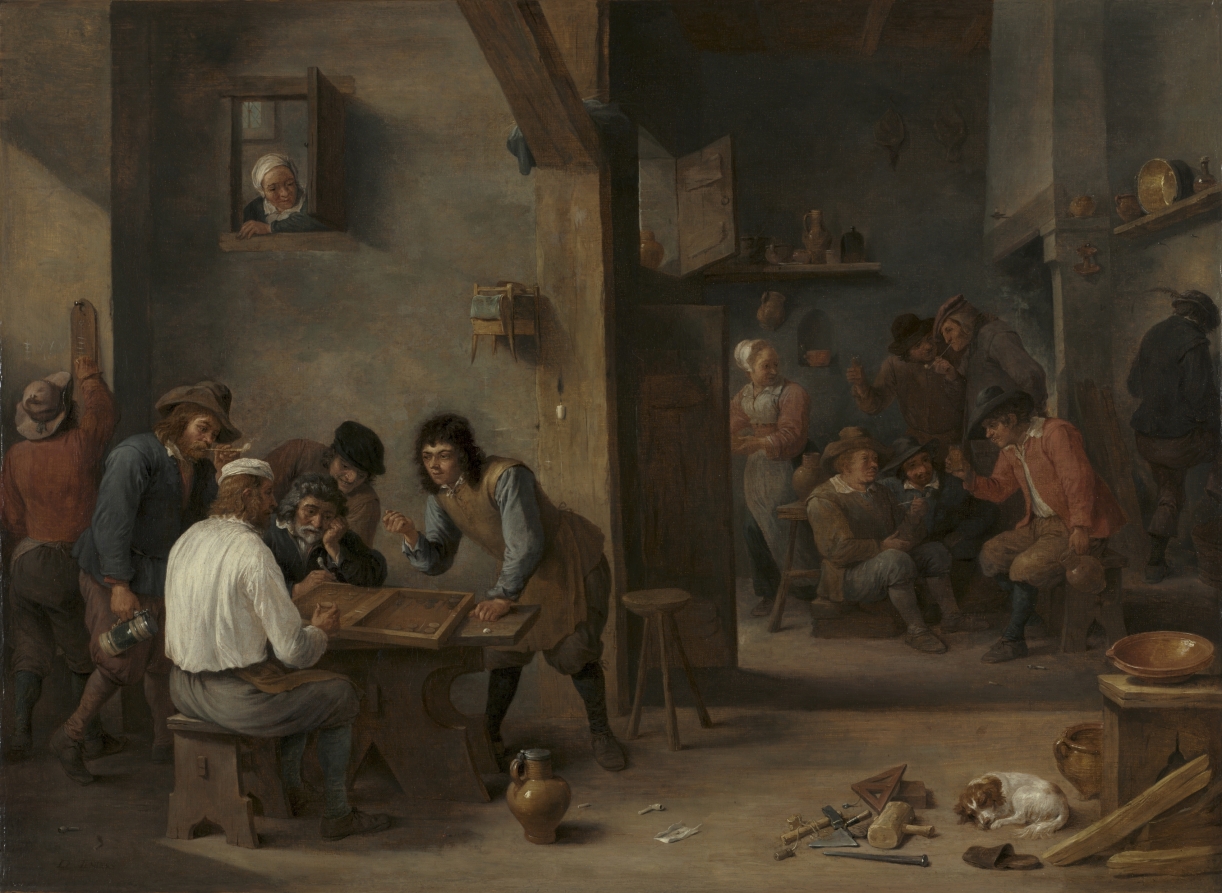
Game of Backgammon
David TeniersLinkedCulture matchlcp-110718ec8366
- Date
- 1640s
- Medium
- oil on wood, transferred to canvas
- Culture
- Flanders
- Department
- European Painting and Sculpture
- Institution
- Cleveland Museum of Art
- Object ID
- 123149
From the Cleveland Museum of Art record
The game of backgammon has a long and popular history which can be traced back many centuries. The version of the game as it is played in modern times first appeared in the 1400s under various names. Its current appellation was coined around the same time as the date of this painting. Backgammon was exceptionally popular in the 1600s, and was often played for money or other wagers. The two men on the left side of this painting are clearly involved in a high stakes game of backgammon. A three-man cluster has gathered to watch them lay their bets, while another tallies their points on a scoreboard. The young lady in the right corner of the room otherwise surrounded by men and the older women who looks down on the game of backgammon from a window, both indicate that the interior presented in this painting is probably the gaming room of a brothel. Courtesans often worked out of such game rooms, providing further entertainment for men. Depictions of games, like procurement scenes, often symbolized moralizing virtues. Games were considered at best folly and at worst immoral. Backgammon was often used to represent the foolishness or wickedness of betting and wasting one's time.
The authoritative record is held by Cleveland Museum of Art. LinkedCulture surfaces this object and its connections; it does not alter institutional metadata.
Get printable QR codesHide QR codes
Open QR codes for this object page and the museum record. They stay collapsed until needed.
Provenance & credit
As published by the source institution. Coverage varies — not every institution's open-data feed includes ownership history.
- Credit line
- Gift of Mr. and Mrs. Samuel D. Wise
- Provenance
- 1674-1723: Philippe II, Duke of Orléans (1674–1723), Regent of France | 1723-1752: Louis I Duke of Orléans (1703–1752) | 1752-1785: Louis Philippe I (1725–1785), Duke of Orléans | 1785-1792: Louis-Philippe II (1747–1793), Duke of Orléans / Philippe Égalité | 1792-1793: Brought to London by Thomas Moore Slade, (exhibited for sale in the Royal Academy, London, April 1793) | George Hibbert (1757–1837), London, England | -1816: Thomas Penrice (d. 1816), Great Yarmouth, England, by inheritance to John Penrice | 1816-1844: John Penrice Sr. (1787-1844), sold, Christie's | July 6, 1844: (Sale: Christie's, London, England, 07/06/1844, to Farrer) | 1844-: Farrer | -1925: Private collection, sold, Christie's, London | July 17, 1925: (Sale: Christie's, London, England, 07/17/1925, no. 119 through S. A. Hecht, London, England to Mr. and Mrs. Samuel Wise) | 1925-1943: Mr. and Mrs. Samuel D. Wise (Cleveland, Ohio), by gift to the Cleveland Museum of Art, 1943 | 1943-: The Cleveland Museum of Art, Cleveland, OH
Related across collections
Semantically similar works from Cleveland Museum of Art and other institutions.