Cleveland Museum of Art
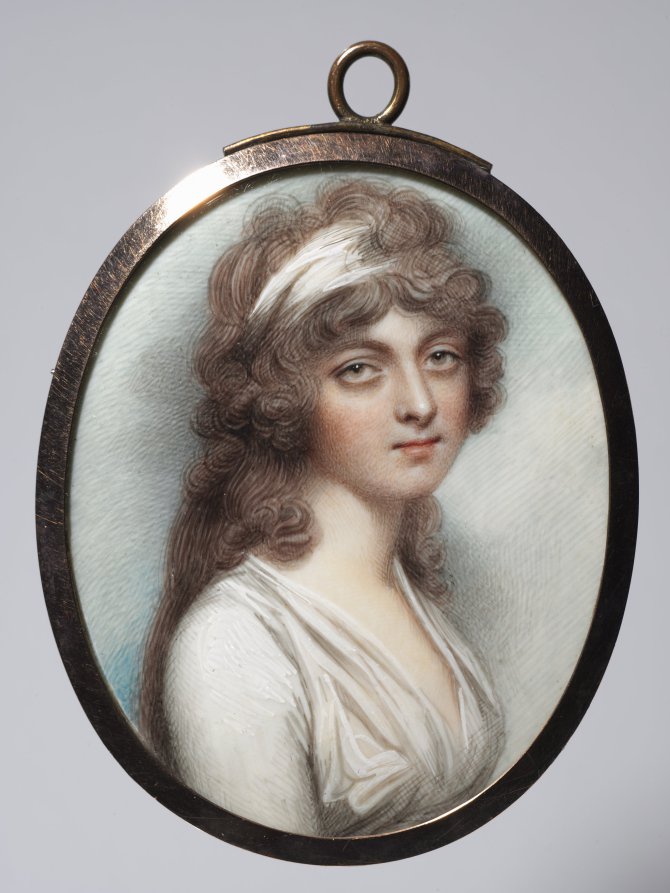
Portrait of Anna Walmesley
Andrew PlimerLinkedCulture matchlcp-0bec3fc0bfb5
- Date
- 1795
- Medium
- watercolor on ivory in a gold frame with hair reverse
- Culture
- England, 18th century
- Department
- European Painting and Sculpture
- Institution
- Cleveland Museum of Art
- Object ID
- 123417
From the Cleveland Museum of Art record
Sons of a clockmaker, Nathaniel Plimer and his younger brother Andrew initially trained in their father's profession, although they grew restless with this trade, and ran off to live with Gypsies for two years. By 1781, they were together in London, and determined to practice art. Both took up residence with established artists. Nathaniel worked as a servant to the enamelist Henry Bone, and Andrew became the valet to the portrait and miniature painter Richard Cosway. Cosway discovered Andrew copying one of his miniatures and introduced him to miniature painting. Andrew assimilated his master's airy execution and adapted Cosway's linear brushwork that leaves much of the bare ivory visible. He also employed Cosway's use of large, expressive eyes that made his miniatures appear soulfully elegant, earning him high praise among legions of admirers. A quick study, Andrew set up his own studio by 1786 and he exhibited regularly at the Royal Academy of Arts from 1786–1830. Andrew Plimer's works fall into two phases. In the first, his sitters appear more naturalistically rendered than those painted after around 1789. During the earlier period he frequently included his initials, "A.P.," on the front of the miniature, followed by a date. By contrast, he did not sign or date works in the second phase. Furthermore, in Andrew's second phase of work, he reduced his palette and, perhaps due to his high output, sitters share many visual characteristics; in particular, his women have elongated necks, long noses, and large appealing eyes. Engraved on the top of the frame is the name Anna Walmesley, but because this was a common name, the museum has yet to discover any information about the sitter or to confirm her identity.
The authoritative record is held by Cleveland Museum of Art. LinkedCulture surfaces this object and its connections; it does not alter institutional metadata.
Get printable QR codesHide QR codes
Open QR codes for this object page and the museum record. They stay collapsed until needed.
Provenance & credit
As published by the source institution. Coverage varies — not every institution's open-data feed includes ownership history.
- Credit line
- The Edward B. Greene Collection
- Provenance
- Before 1930: Walmesley Family | -1930: (Leo Schidlof, Paris, France, sold to Edward B. Greene). | 1930-1943: Edward B. Greene (1878-1957), Cleveland, OH, gifted to the Cleveland Museum of Art | 1943-: The Cleveland Museum of Art, Cleveland, OH
Part of a LinkedCulture topic
 English Portrait Miniatures
A collection of portrait miniatures from 17th-18th century England, predominantly featuring watercolor on ivory or graphite and wash techniques, representing the tradition of intimate personal portraiture in miniature fo
221 objects from 4 institutions
Related across collections
Semantically similar works from Cleveland Museum of Art and other institutions.