Cleveland Museum of Art
Adam and Eve
Albrecht DürerLinkedCulture matchlcp-91cf98b472c5
- Date
- 1504
- Medium
- engraving
- Culture
- Germany, early 16th Century
- Department
- Prints
- Institution
- Cleveland Museum of Art
- Object ID
- 123964
What the image shows
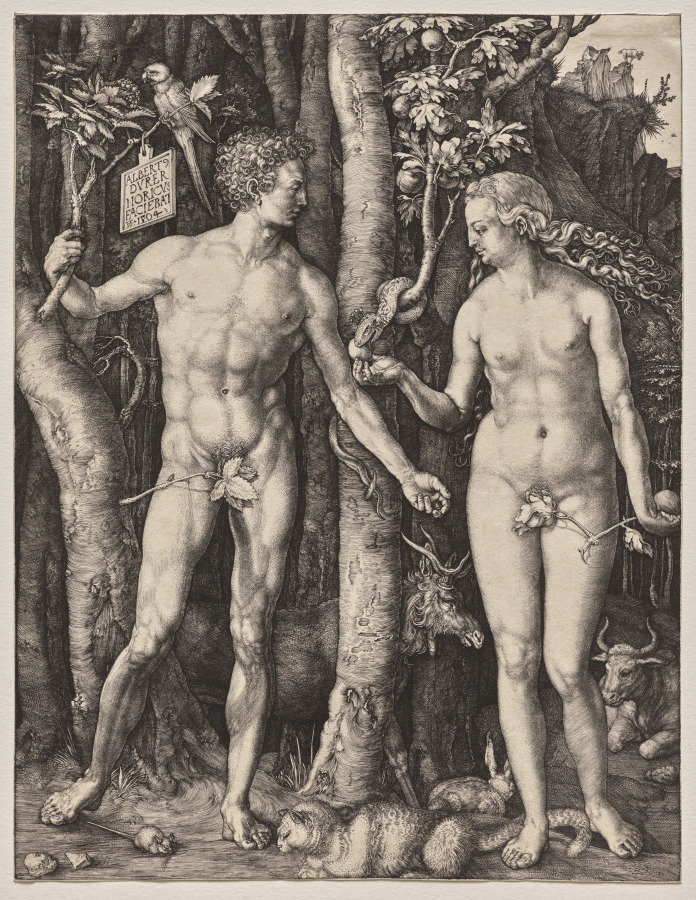
Adam and Eve stand in a forested area, holding hands and surrounded by animals.
Generated by LinkedCulture from the photograph alone, without the museum’s catalogue text (Qwen/Qwen2.5-VL-7B-Instruct), and not yet reviewed by a person. It describes the picture, not the object’s history, and it is not part of the museum’s record.
From the Cleveland Museum of Art record
Albrecht Dürer’s iconic engraving was hugely impactful to the spread of natural symbolism in Europe. Drawing upon Classical sculptural models, he represented Adam and Eve in perfect, uncorrupted beauty moments before tasting the forbidden fruit. The tree of knowledge, with its writhing serpent, is a fig tree, and the tree of life, which Adam clasps, a mountain ash, native to Northern Europe. The elk, rabbit, cat, and ox are symbols of the four human temperaments—melancholic (gloomy), sanguine (sensual), choleric (cruel), and phlegmatic (slothful)—in perfect balance. But the cat and mouse hint at aggression to come, and the parrot, appearing like a beacon in the dark northern forest, heralds the promise of the Virgin Mary (the new Eve). Albrecht Dürer set the Garden of Eden in a northern forest, with the tree of knowledge represented by a fig tree and the tree of life, a mountain ash.
The authoritative record is held by Cleveland Museum of Art. LinkedCulture surfaces this object and its connections; it does not alter institutional metadata.
Get printable QR codesHide QR codes
Open QR codes for this object page and the museum record. They stay collapsed until needed.
Provenance & credit
As published by the source institution. Coverage varies — not every institution's open-data feed includes ownership history.
- Credit line
- Dudley P. Allen Fund
- Provenance
- -1944: Ex. Coll., British Museum (Lugt 300), duplicate (Lugt 305)
Related across collections
Semantically similar works from Cleveland Museum of Art and other institutions.