Cleveland Museum of Art
The Great Triumphal Car of Emperor Maximilian
Albrecht DürerLinkedCulture matchlcp-91cf98b472c5
- Date
- c. 1523
- Medium
- woodcut
- Culture
- Germany
- Department
- Prints
- Institution
- Cleveland Museum of Art
- Object ID
- 124274
From LinkedCulture
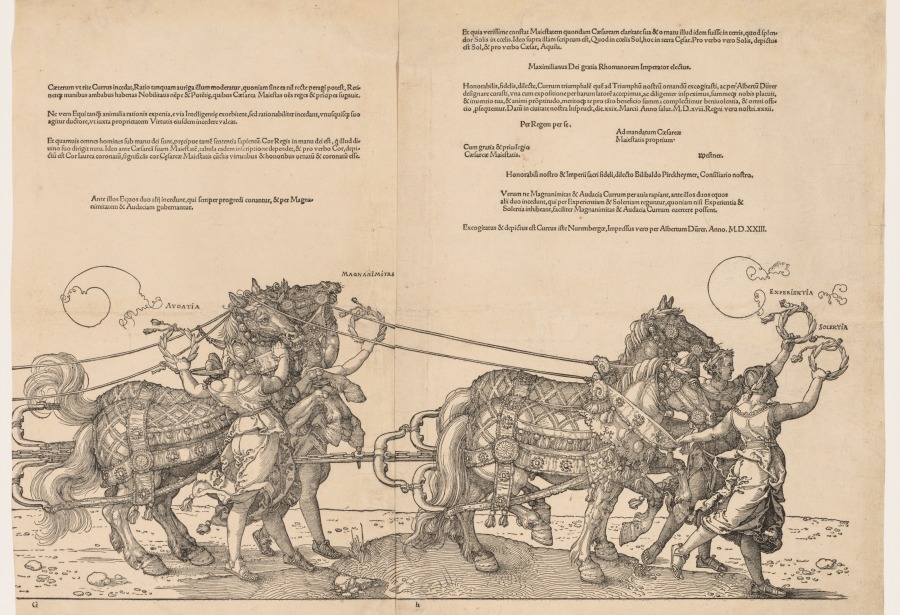
This woodcut chariot was never meant to be just art. It was imperial propaganda, designed by Albrecht Dürer around 1523 to glorify Holy Roman Emperor Maximilian I, who died before the project was ever finished. Dürer published it at his own expense, and you can see why it mattered. The horses strain forward in precise detail, surrounded by labeled allegorical figures representing the qualities of a perfect ruler, with wheels literally inscribed with Magnificence, Honor, Dignity, and Glory.
Written by LinkedCulture for its video on this object. Machine-generated (claude-sonnet-4-6), not yet reviewed by a person. It is not part of the museum’s record.
What the image shows
A detailed drawing of a chariot pulled by two horses, adorned with intricate patterns, with two figures riding it.
Generated by LinkedCulture from the photograph alone, without the museum’s catalogue text (Qwen/Qwen2.5-VL-7B-Instruct), and not yet reviewed by a person. It describes the picture, not the object’s history, and it is not part of the museum’s record.
From the Cleveland Museum of Art record
Dürer conceived this fantastical chariot as part of a larger commission to depict Holy Roman Emperor Maximilian I (reigned 1486–1519) in a triumphal procession. The ruler sits enthroned in the lavish car, as Victory holds a laurel wreath above his imperial crown. Her feathered wings list Maximilian’s military campaigns. Nearly every component of the allegorical pageant—from the entourage of female attendants to the laurel garlands—has a Latin label describing honorable qualities of an ideal prince. The car rolls on wheels of Magnificence, Honor, Dignity, and Glory. Its driver is Reason, who guides a team of 12 horses with reins of Nobility and Power. Virtues of Justice, Strength, Wisdom, and Temperance, stand on pedestals arranged around the emperor. Maximilian died in 1519, before the ambitious commission could be completed. Dürer published The Great Triumphal Car at his own expense with text composed by his friend Willibald Pirckheimer (1470–1530).
The authoritative record is held by Cleveland Museum of Art. LinkedCulture surfaces this object and its connections; it does not alter institutional metadata.
Get printable QR codesHide QR codes
Open QR codes for this object page and the museum record. They stay collapsed until needed.
Provenance & credit
As published by the source institution. Coverage varies — not every institution's open-data feed includes ownership history.
- Credit line
- Dudley P. Allen Fund
- Provenance
- with Richard H. Zinser, New York | 1945: Purchased by the Cleveland Museum of Art, Cleveland, OH
Related across collections
Semantically similar works from Cleveland Museum of Art and other institutions.