Cleveland Museum of Art
Altar Front
- Date
- c. 540–600
- Medium
- marble
- Culture
- early Byzantium, Constantinople or Ravenna, Byzantine period, 6th century
- Department
- Medieval Art
- Institution
- Cleveland Museum of Art
- Object ID
- 126030
From the Cleveland Museum of Art record
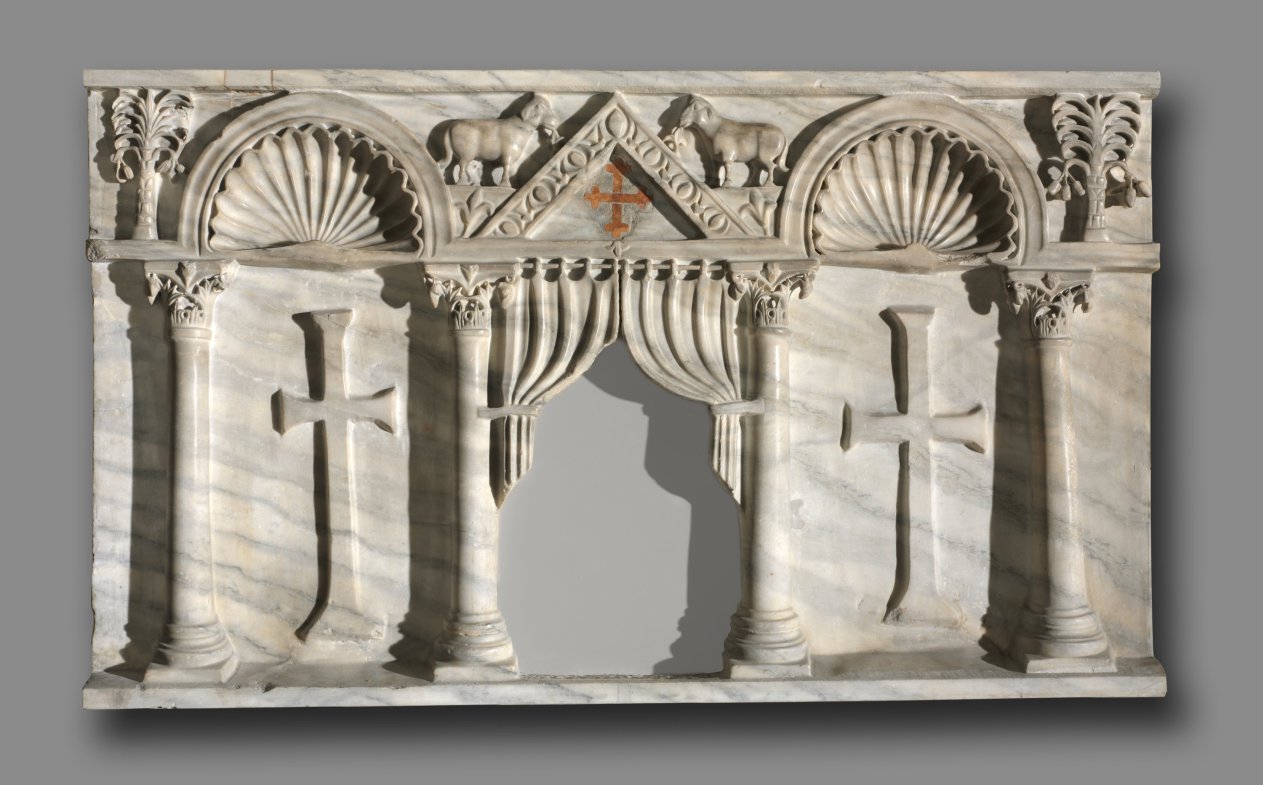
This carved marble panel resembles the front of an Early Byzantine sarcophagus, or coffin. While its decoration is typical of those produced in the Italian city of Ravenna during the 500s, its size is considerably smaller, indicating that the panel may instead have been made as an altar front. It is likely that the small window between the center columns with its opened curtains once allowed the faithful to contemplate a precious reliquary placed inside. The decorative repertoire of the panel includes both architectural forms--arches, pediments, and columns--and a number of symbols commonly found in Early Christian art including scallop shells, lambs, palms, and crosses that represent the concepts of life, the sacrifice of Christ, victory over death, and eternal life. This marble altar was likely in a Byzantine church that was opulently decorated with mosaics, rich textiles, and gilded lamps. Worshipers would have witnessed the rituals of faith that occurred at the altar, enshrined behind a barrier called a templon, and accessible only to the clergy.
The authoritative record is held by Cleveland Museum of Art. LinkedCulture surfaces this object and its connections; it does not alter institutional metadata.
Get printable QR codesHide QR codes
Open QR codes for this object page and the museum record. They stay collapsed until needed.
Provenance & credit
As published by the source institution. Coverage varies — not every institution's open-data feed includes ownership history.
- Credit line
- John L. Severance Fund
- Provenance
- Originally from S. Carlino (formerly S. Fabiano and S. Sebastiano), Ravenna | Villa Lovatelli near Ravenna | Villa Landau near Florence, Finaly Collection | ?-1948: (Adolph Loewi, Los Angeles), sold to the Cleveland Museum of Art | 1948-: The Cleveland Museum of Art, Cleveland, OH
Related across collections
Semantically similar works from Cleveland Museum of Art and other institutions.