Cleveland Museum of Art
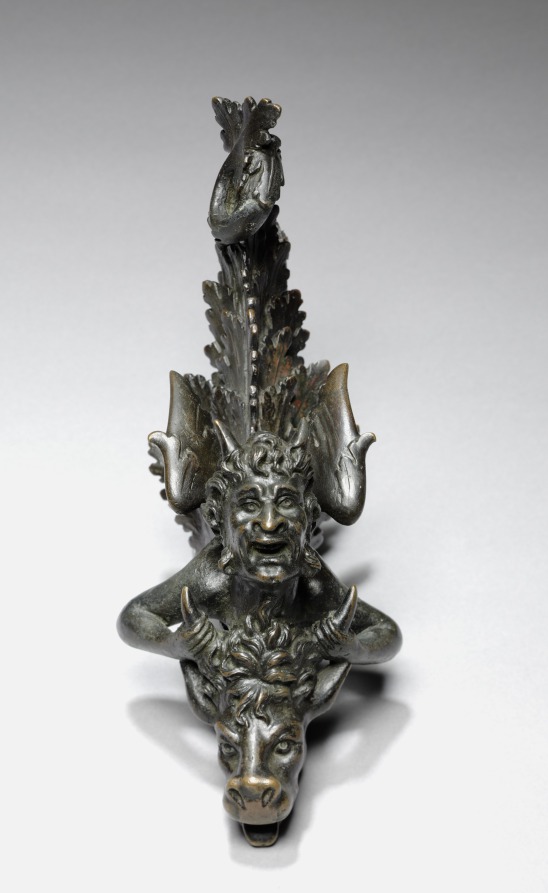
Doorknocker with a Satyr Pulling an Ox's Horns
Andrea RiccioLinkedCulture matchlcp-3e4f65b7e489
- Date
- 1800s
- Medium
- bronze
- Culture
- Italy, early 16th Century
- Department
- European Painting and Sculpture
- Institution
- Cleveland Museum of Art
- Object ID
- 126278
From the Cleveland Museum of Art record
Fanciful bronzes such as this one were extremely popular in the late 1500s in the north of Italy, where sculptors such as Andrea Riccio and Severo da Ravenna often featured bizarre imaginary creatures in their sculptures. These artists exerted a long-lasting influence on their peers and followers for the remainder of the 1500s. However, this sculpture was not made in the 1500s. Based on the weight and style of the Doorknocker , it is most likely that it was made in the 1800s to mimic the style of Riccio and his followers. This sculpture is solid; in the 1500s artists created hollow sculptures to reduce the costs of the object and to decrease the chances of flaws in the sculpture. However, in the 1800s when better bronze casting technology evolved and the price of the metal was less costly, artists created solid bronze sculptures based on sixteenth-century designs. In particular, there was a considerable market in England for Renaissance revival doorknockers to be used decoratively on pub doors.
The authoritative record is held by Cleveland Museum of Art. LinkedCulture surfaces this object and its connections; it does not alter institutional metadata.
Get printable QR codesHide QR codes
Open QR codes for this object page and the museum record. They stay collapsed until needed.
Provenance & credit
As published by the source institution. Coverage varies — not every institution's open-data feed includes ownership history.
- Credit line
- Gift of Mr. and Mrs. Severance A. Millikin
- Provenance
- Dr. Ernö Wittmann (Budapest, Hungary) | R. Stora & Co. (New York, New York), by 1948, sold to Mr. and Mrs. Severance A. Millikin, 1948. | Mr. and Mrs. Severance A. Millikin, by gift to the Cleveland Museum of Art, 1948.
Related across collections
Semantically similar works from Cleveland Museum of Art and other institutions.