Cleveland Museum of Art
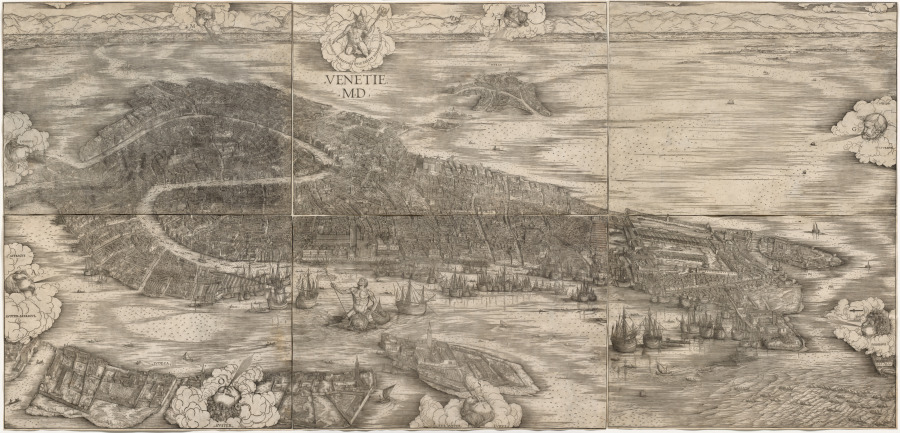
View of Venice
Jacopo de' BarbariLinkedCulture matchlcp-70dc26bb0a76
- Date
- 1500
- Medium
- woodcut from six blocks on six sheets of paper
- Culture
- Italy, early 16th Century
- Department
- Prints
- Institution
- Cleveland Museum of Art
- Object ID
- 127250
From the Cleveland Museum of Art record
By the end of the 1400s, Venice had emerged as the major printing center in Europe, where books were printed in various languages to be shipped around the world. The city also became the great emporium for prints, and the woodcut developed beyond its humble origins as a popular art for devotional imagery, playing cards, and later for book illustration. View of Venice epitomizes this new ambitious scope for the woodcut, and is a landmark in the history of printmaking. This monumental print can be compared in scale only to a mural decoration and presumably served as a less expensive surrogate for paintings. The six sheets that make up the design would have been pasted either onto a canvas or the wall itself, resulting in the survival of only 12 impressions of the original edition like this one, and only three in America. The goal of the print was to depict Venice as seen from above. No single vantage point would have been sufficient, so Jacopo de' Barbari and a team of surveyors climbed various towers and tall buildings to record small sections of the city. These individual views were combined to form the map which follows a single, though inconsistent, system of perspective. Unprecedented for its exactness of detail and difficulty of execution, View of Venice represents the first attempt to render the image of a city according to the laws of geometry. The view also highlights the seafaring trade activities of Venice, depicting Mercury, god of commerce, presiding over the city, while Neptune, god of the seas, keeps watch over the entrance to the city's Grand Canal. Before the conveniences of airplanes, photography, or even a hot air balloon this monumental bird's-eye view map of Venice made in 1500 documents every building, canal, alleyway, and square in the city.
The authoritative record is held by Cleveland Museum of Art. LinkedCulture surfaces this object and its connections; it does not alter institutional metadata.
Get printable QR codesHide QR codes
Open QR codes for this object page and the museum record. They stay collapsed until needed.
Provenance & credit
As published by the source institution. Coverage varies — not every institution's open-data feed includes ownership history.
- Credit line
- Purchase from the J. H. Wade Fund
- Provenance
- ?-?1947: Prince of Liechtenstein, Vienna | 1949-: The Cleveland Museum of Art, Cleveland, OH
Related across collections
Semantically similar works from Cleveland Museum of Art and other institutions.