Cleveland Museum of Art
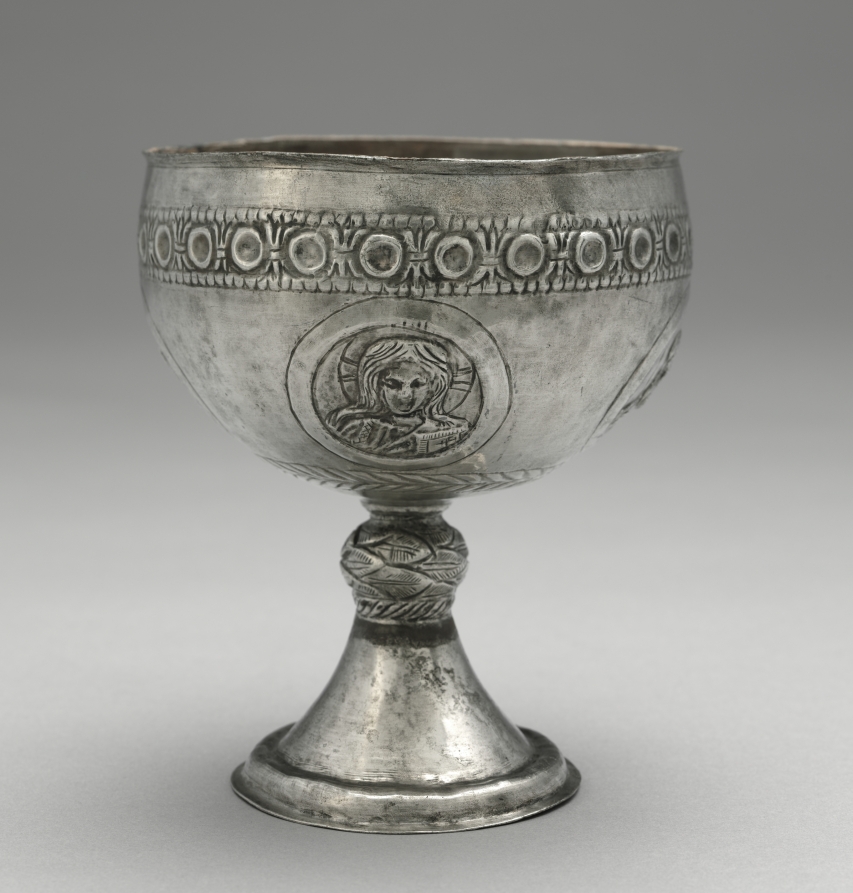
Chalice from the Beth Misona Treasure
- Date
- c. 500–700
- Medium
- silver
- Culture
- early Byzantium, Constantinople or Syria, Byzantine period, 6th-7th Century
- Department
- Medieval Art
- Institution
- Cleveland Museum of Art
- Object ID
- 127718
From the Cleveland Museum of Art record
These four liturgical silver vessels—a paten and three chalices (1950.378–81)—form what is now called the Beth Misona Treasure, named for the village in northern Syria for which the objects were made. While nothing is known about the exact location and circumstances of the treasure's discovery, the people of the village of Beth Misona were, like other Christian communities in Syria and Palestine, probably forced to bury their church silver to hide it from the Persians or Arabs, who conquered their lands in the first half of the 600s. The paten, which held pieces of Eucharistic bread used during Mass, is decorated with an engraved Latin cross surrounded by a dedicatory inscription that names the paten's donor—Domnos—and its original location, the church of Saint Sergios in Beth Misona. The chalices, which contained the Eucharistic wine used during Mass, feature broad cups decorated with portrait busts of Saints Peter and Paul, Christ, and the Virgin. One chalice bears a dedicatory inscription naming its donor—Kyriakos, Domnos's son—and the priest of the church that received the pious gift—Zeno.
The authoritative record is held by Cleveland Museum of Art. LinkedCulture surfaces this object and its connections; it does not alter institutional metadata.
Get printable QR codesHide QR codes
Open QR codes for this object page and the museum record. They stay collapsed until needed.
Provenance & credit
As published by the source institution. Coverage varies — not every institution's open-data feed includes ownership history.
- Credit line
- Purchase from the J. H. Wade Fund
- Provenance
- Jacques O. Matossian; (Paul Mallon, New York).
Related across collections
Semantically similar works from Cleveland Museum of Art and other institutions.