Cleveland Museum of Art
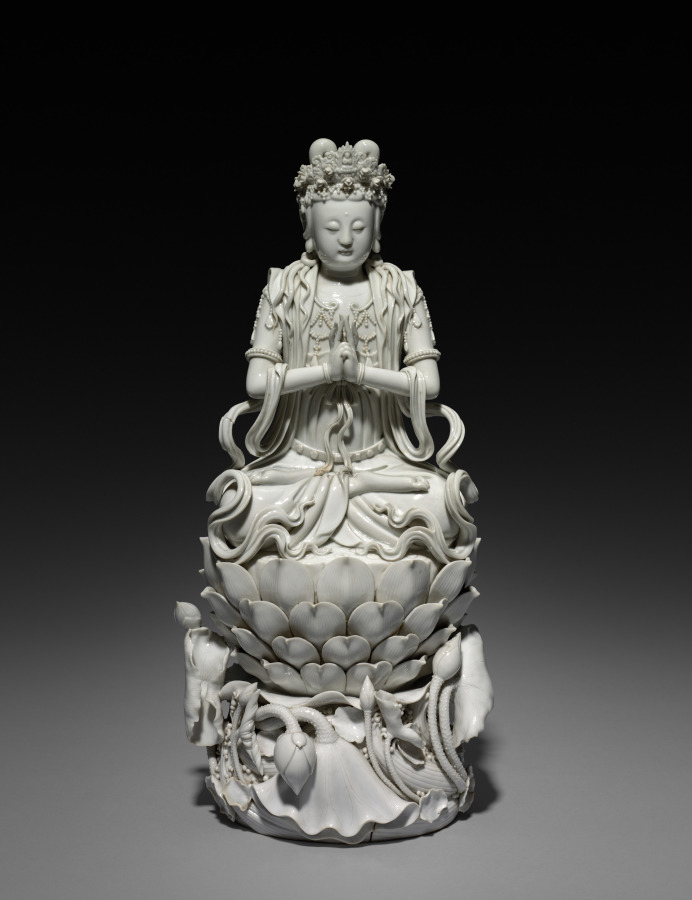
Bodhisattva Guanyin of the South Sea
- Date
- 1600s
- Medium
- Porcelain with white glaze, Dehua ware
- Culture
- China, Fujian Province, Ming dynasty (1368-1644) - Qing dynasty (1644-1911)
- Department
- Chinese Art
- Institution
- Cleveland Museum of Art
- Object ID
- 127950
From the Cleveland Museum of Art record
Guanyin, the Buddhist bodhisattva of infinite compassion (Avalokiteshvara in Sanskrit), is the most revered enlightened being in East Asia. The bodhisattva perceives all beings in need of help and reveals himself in many forms. Here, his elaborate lotus pedestal rests on the crest of surging waves, identifying him as Guanyin of the South Seas. The Dehua kilns in Fujian province in southern China produced white porcelain figures for both the domestic and export markets. In China, such a figure may have furnished a house altar or a temple. When Marco Polo visited China in the late 1200s, he was so impressed by the Dehua kilns that he included lengthy descriptions of ceramic production in his chronicle of his journey.
The authoritative record is held by Cleveland Museum of Art. LinkedCulture surfaces this object and its connections; it does not alter institutional metadata.
Get printable QR codesHide QR codes
Open QR codes for this object page and the museum record. They stay collapsed until needed.
Provenance & credit
As published by the source institution. Coverage varies — not every institution's open-data feed includes ownership history.
- Credit line
- The Norweb Collection
- Provenance
- ?–1950: Mrs. R. Henry [Emery May Holden] Norweb [1895-1984], Cleveland, OH, given to the Cleveland Museum of Art | 1950–: The Cleveland Museum of Art, Cleveland, OH
Part of a LinkedCulture topic
 Buddhist and Hindu Iconography
These objects are connected by their representation of sacred figures and deities from Buddhist and Hindu religious traditions across Asian cultures, including sculptures, paintings, and ritual objects depicting buddhas,
183 objects from 5 institutions
Related across collections
Semantically similar works from Cleveland Museum of Art and other institutions.