Cleveland Museum of Art
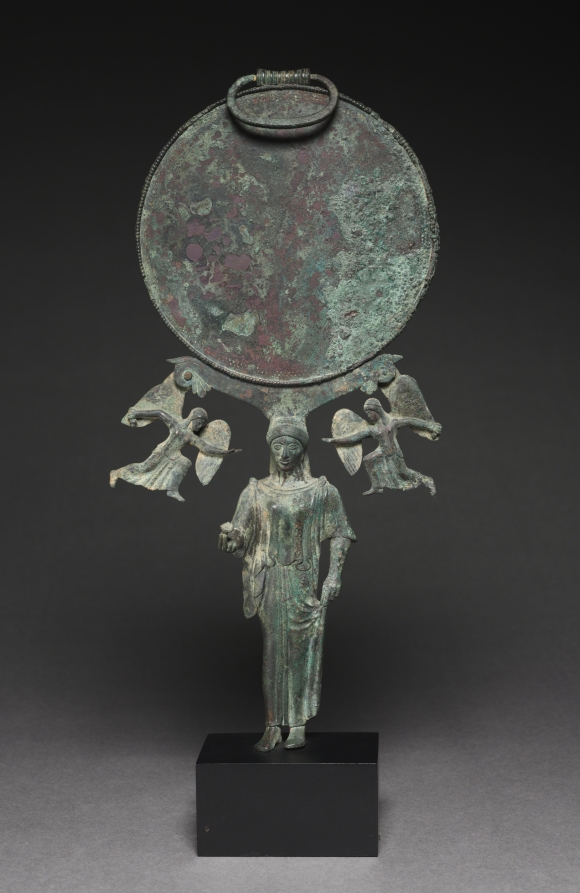
Mirror
- Date
- c. 470–460 BCE
- Medium
- bronze
- Culture
- Greece, Sicyon(?)
- Department
- Greek and Roman Art
- Institution
- Cleveland Museum of Art
- Object ID
- 128045
From the Cleveland Museum of Art record
Named for their figured handles, Greek caryatid mirrors may derive from similar types created in ancient Egypt many centuries earlier (like CMA 1983.196 ). Greek caryatid handles typically take the form of a beautiful, draped woman like this one, whether mortal or divine (perhaps the love goddess Aphrodite). Often, she holds a small offering, here a flower. The small, winged women (Nikai) flanking her are unusual among such mirrors, which often feature Erotes in this position. In antiquity, the unadorned disk would have been highly polished and reflective, and the figure would have stood on an integrated base. The term caryatid from classical architecture refers to the female figure serving as a support.
The authoritative record is held by Cleveland Museum of Art. LinkedCulture surfaces this object and its connections; it does not alter institutional metadata.
Get printable QR codesHide QR codes
Open QR codes for this object page and the museum record. They stay collapsed until needed.
Provenance & credit
As published by the source institution. Coverage varies — not every institution's open-data feed includes ownership history.
- Credit line
- Purchase from the J. H. Wade Fund
- Provenance
- Sir Francis Cook, Richmond, England | 1908?: Wyndham F. Cook | ?-1925: Humphrey W. Cook | 1925: (Christie, Manson, & Wood, July 14, 1925) | ?-1940: (The International Studio Art Corp, Sold to Joseph Brummer Gallery) | 1940-1950: (Joseph Brummer Gallery, New York, NY, Sold to the Cleveland Museum of Art) | 1950-: The Cleveland Museum of Art, Cleveland, OH
Related across collections
Semantically similar works from Cleveland Museum of Art and other institutions.