Cleveland Museum of Art
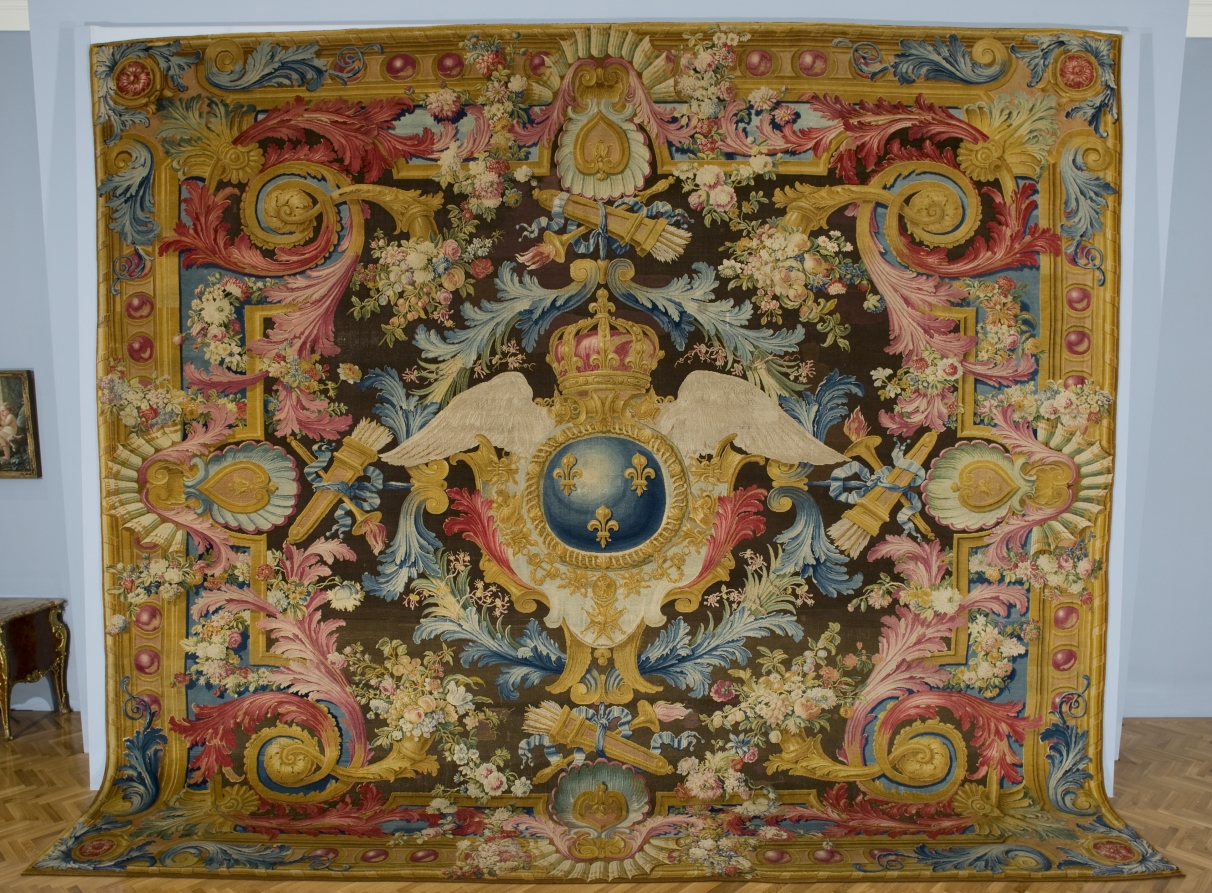
Louis XV Savonnerie Carpet with Royal Arms
Royal Savonnerie Manufactory, Chaillot WorkshopsLinkedCulture matchlcp-74642f788845
- Date
- c. 1740–50
- Medium
- Savonnerie knotted pile (symmetrical ruf knot), wool, hemp
- Culture
- France, 18th century
- Department
- Textiles
- Institution
- Cleveland Museum of Art
- Object ID
- 128056
From the Cleveland Museum of Art record
This spectacular carpet, one of three with this royal pattern, was originally designed for Louis XV’s dining room at chateau La Muette by the prominent Savonnerie artist Pierre-Josse Perrot in 1735. The royal arms of France on the orb are topped by a crown with eagle’s wings. Cornucopia issue from corner pieces that alternate with military trophies. The lively artistic style was simplified for faster weaving and a brown ground was used to heighten the brilliant colors.The Savonnerie factory was founded in the early 1600s to create French versions of Oriental carpets, whose import had created a drain on the economy. The technique, copying Turkish carpets, has wool pile formed with symmetrical rug-knots, wool warps, and hemp wefts.
The authoritative record is held by Cleveland Museum of Art. LinkedCulture surfaces this object and its connections; it does not alter institutional metadata.
Get printable QR codesHide QR codes
Open QR codes for this object page and the museum record. They stay collapsed until needed.
Provenance & credit
As published by the source institution. Coverage varies — not every institution's open-data feed includes ownership history.
- Credit line
- John L. Severance Fund
- Provenance
- made for Louis XV to present to Stanislaus of Poland (1677-1766), the son of Raphael Leczinsky, Grand Treasurer of Poland. When Charles XII of Sweden dethroned August II, King of Poland and Elector of Saxony, Stanislaus was elected King of Poland in 1705; the result of the Battle of Pultowa obliged him to abdicate, and he lived afterwards in the Castle of Nancy, France, where is seems likely this carpet was placed. (A. & R. Ball, New York).
Part of a LinkedCulture topic
 18th-Century French Decorative Arts
These objects represent the luxury decorative traditions of 18th-century France, unified by their use of refined materials (tapestry weave, Savonnerie knotted pile, carved wood), classical themes (Ovid's Metamorphoses, S
48 objects from 5 institutions
Related across collections
Semantically similar works from Cleveland Museum of Art and other institutions.