Cleveland Museum of Art
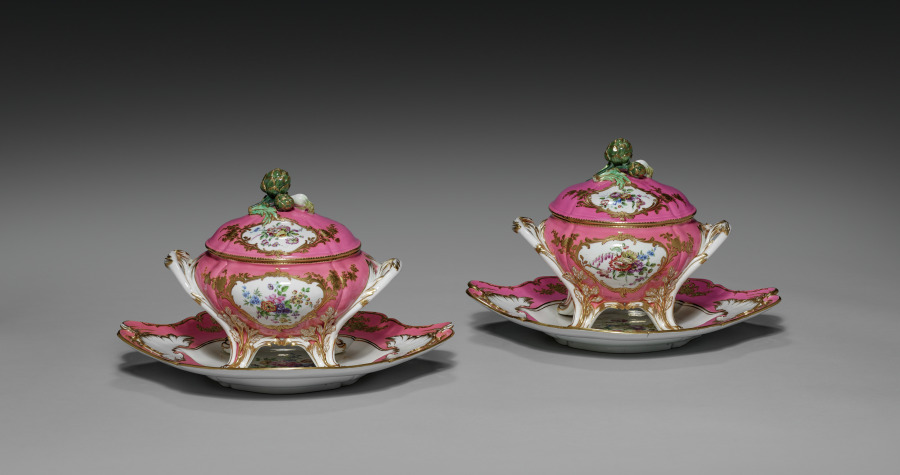
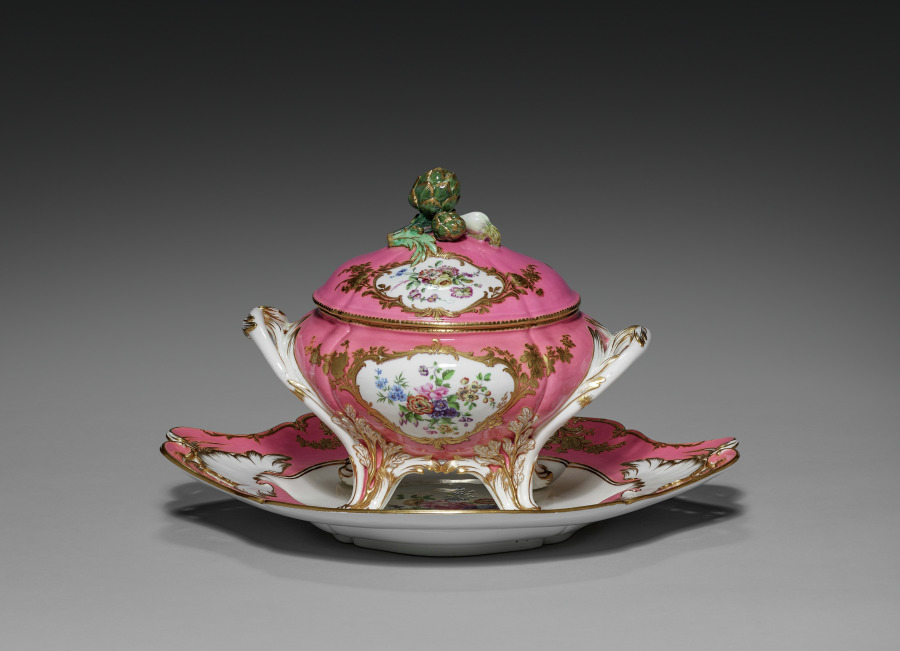
Pair of Covered Tureens on Stand (Paire de pots-à-oille)
Sèvres Porcelain FactoryLinkedCulture matchlcp-b2a5e868c6d8
- Date
- 1757–58
- Medium
- soft-paste porcelain with enamel and gilt decoration
- Culture
- France, Sèvres
- Department
- Decorative Art and Design
- Institution
- Cleveland Museum of Art
- Object ID
- 130499
What the image shows
Two ornate porcelain containers with lids and saucers, featuring pink and gold designs.
Generated by LinkedCulture from the photograph alone, without the museum’s catalogue text (Qwen/Qwen2.5-VL-7B-Instruct), and not yet reviewed by a person. It describes the picture, not the object’s history, and it is not part of the museum’s record.
From the Cleveland Museum of Art record
A misconception influenced by 19th-century art historical texts, the pale pink that appears on Sèvres porcelain is commonly and incorrectly called rose Pompadour after Madame de Pompadour, official mistress of French King Louis XV. Though she was a great patron of the factory, this pale pink ground did not carry her name during its mid-18th-century production. Instead, factory records refer to this striking pink simply as rose. Oille , which may come from the Spanish word for cooking pot, olla , refers to a Spanish stew of meat and vegetables popularized by Anne of Austria and Maria-Theresa, respective wives of Louis XIII and Louis XIV.
The authoritative record is held by Cleveland Museum of Art. LinkedCulture surfaces this object and its connections; it does not alter institutional metadata.
Get printable QR codesHide QR codes
Open QR codes for this object page and the museum record. They stay collapsed until needed.
Provenance & credit
As published by the source institution. Coverage varies — not every institution's open-data feed includes ownership history.
- Credit line
- John L. Severance Fund
- Provenance
- Countess Redorte, Paris; (Rosenberg and Stiebel, New York).
Part of a LinkedCulture topic
 18th Century Decorative Tureens
All objects are ceramic tureens or tureen components from the 18th-19th centuries, representing European porcelain and faience tableware including both naturalistic forms (cauliflower, turtle, hen) and traditional servin
80 objects from 3 institutions
Related across collections
Semantically similar works from Cleveland Museum of Art and other institutions.