Cleveland Museum of Art
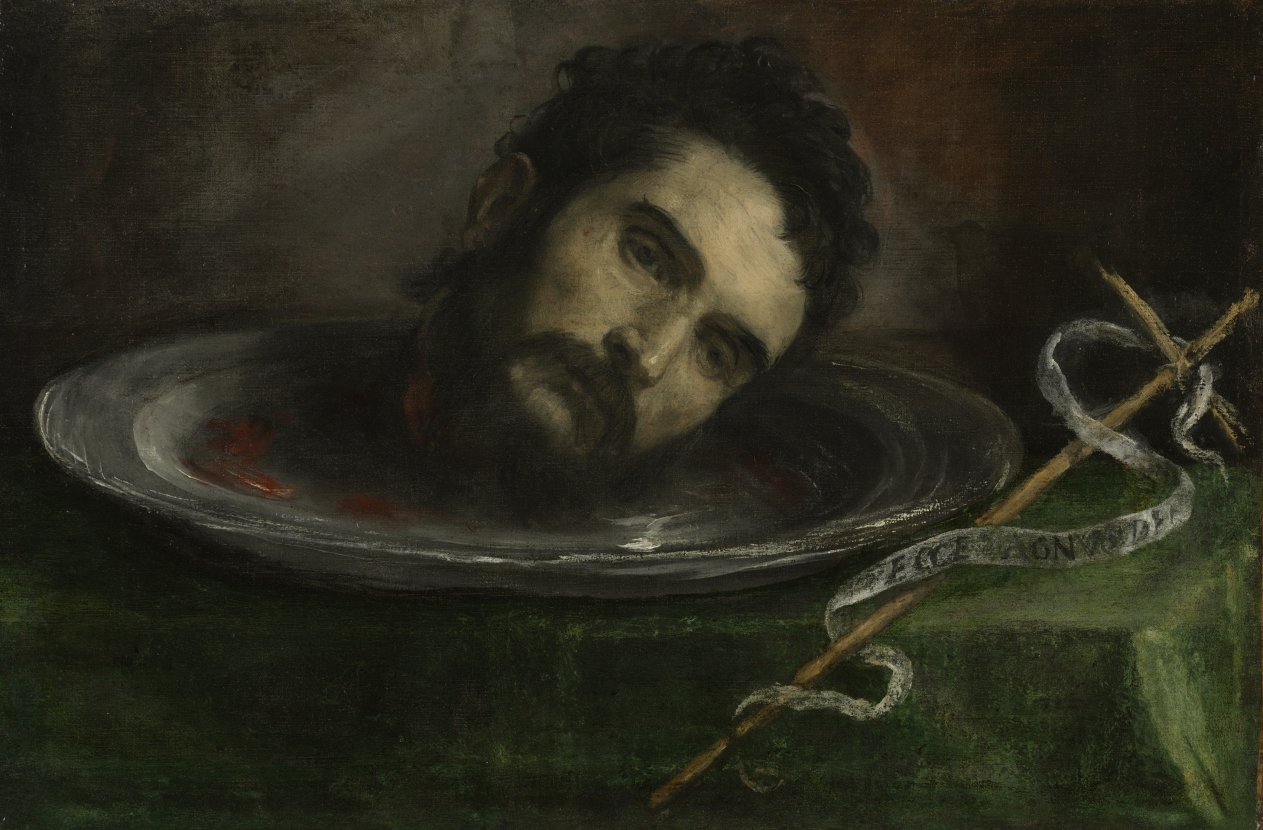
Head of Saint John the Baptist
- Date
- c. 1550–1650
- Medium
- oil on canvas
- Culture
- Spain or Northern Italy, mid 16th - mid 17th century
- Department
- European Painting and Sculpture
- Institution
- Cleveland Museum of Art
- Object ID
- 130707
From the Cleveland Museum of Art record
Salome’s dancing so pleased her stepfather Herod that he offered her anything she wanted. Her mother advised Salome to demand John the Baptist’s head, which Salome presented to her family in an elaborate dish. Here, the head stands on its own, with a startlingly tangible presence. Despite its biblical source, this work was meant for a domestic setting, whose owner would have admired the artful presentation of a shocking story. Acquired in 1953 as the work of the Venetian Renaissance artist Titian, the painting soon lost this attribution because it lacks Titian’s distinctive brushwork. After decades of research, the museum has yet to identify a clear author. Recently, several scholars have argued persuasively for a Spanish artist, partly because the subject is common in Spanish art in the early 1600s. Yet the color scheme and the handling of paint in the face recalls the work of earlier artists inspired by Titian in northern Italy. The scroll wrapped around the cross next to John the Baptist's head reads Ecce Agnus Dei , meaning "Behold the Lamb of God."
The authoritative record is held by Cleveland Museum of Art. LinkedCulture surfaces this object and its connections; it does not alter institutional metadata.
Get printable QR codesHide QR codes
Open QR codes for this object page and the museum record. They stay collapsed until needed.
Provenance & credit
As published by the source institution. Coverage varies — not every institution's open-data feed includes ownership history.
- Credit line
- Mr. and Mrs. William H. Marlatt Fund
- Provenance
- [Alessandro Brass, Venice], sold to the Cleveland Museum of Art, 1953.
Related across collections
Semantically similar works from Cleveland Museum of Art and other institutions.