Cleveland Museum of Art
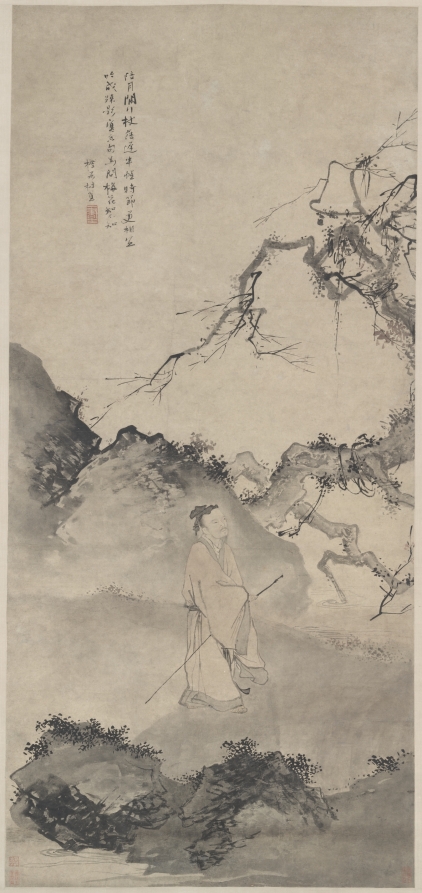
The Poet Lin Bu Wandering in the Moonlight
Du JinLinkedCulture matchlcp-2f32de1032ab
- Date
- late 1400s
- Medium
- Hanging scroll; ink and color on paper
- Culture
- China, Ming dynasty (1368–1644)
- Department
- Chinese Art
- Institution
- Cleveland Museum of Art
- Object ID
- 132015
From the Cleveland Museum of Art record
Lin Bu (967–1028), a Northern Song (960–1127) poet and hermit who lived at the West Lake in Hangzhou, was known for having plum trees for his female companions and cranes for his children. This hanging scroll depicts the poet walking in the moonlight and looking at the plum tree, a scene described in his most well-known poem on plum blossoms. Surviving works signed by Du Jin are rare and this painting is one of them. Here, the artist used lively brushwork to depict the plum tree and rocks, exemplified in varying dots and strokes, and sweeps in different shades of ink. Lin Bu withdrew from prestigious government service and lived as a hermit by the West Lake in Hangzhou.
The authoritative record is held by Cleveland Museum of Art. LinkedCulture surfaces this object and its connections; it does not alter institutional metadata.
Get printable QR codesHide QR codes
Open QR codes for this object page and the museum record. They stay collapsed until needed.
Provenance & credit
As published by the source institution. Coverage varies — not every institution's open-data feed includes ownership history.
- Credit line
- John L. Severance Fund
- Provenance
- Zhang Congyu, Shanghai, China | Zhang Heng 張珩 [1915–1963] | ?–1954: (C. C. Wang 王季遷 [1907–2003], New York, NY, sold to the Cleveland Museum of Art) | 1954–: The Cleveland Museum of Art, Cleveland, OH
Part of a LinkedCulture topic
 Chinese landscape paintings
These are predominantly Chinese paintings from the Ming, Qing, Yuan, and Song dynasties that depict natural landscape scenes including mountains, rivers, forests, and human settlements using traditional media such as ink
180 objects from 5 institutions
Related across collections
Semantically similar works from Cleveland Museum of Art and other institutions.