Cleveland Museum of Art
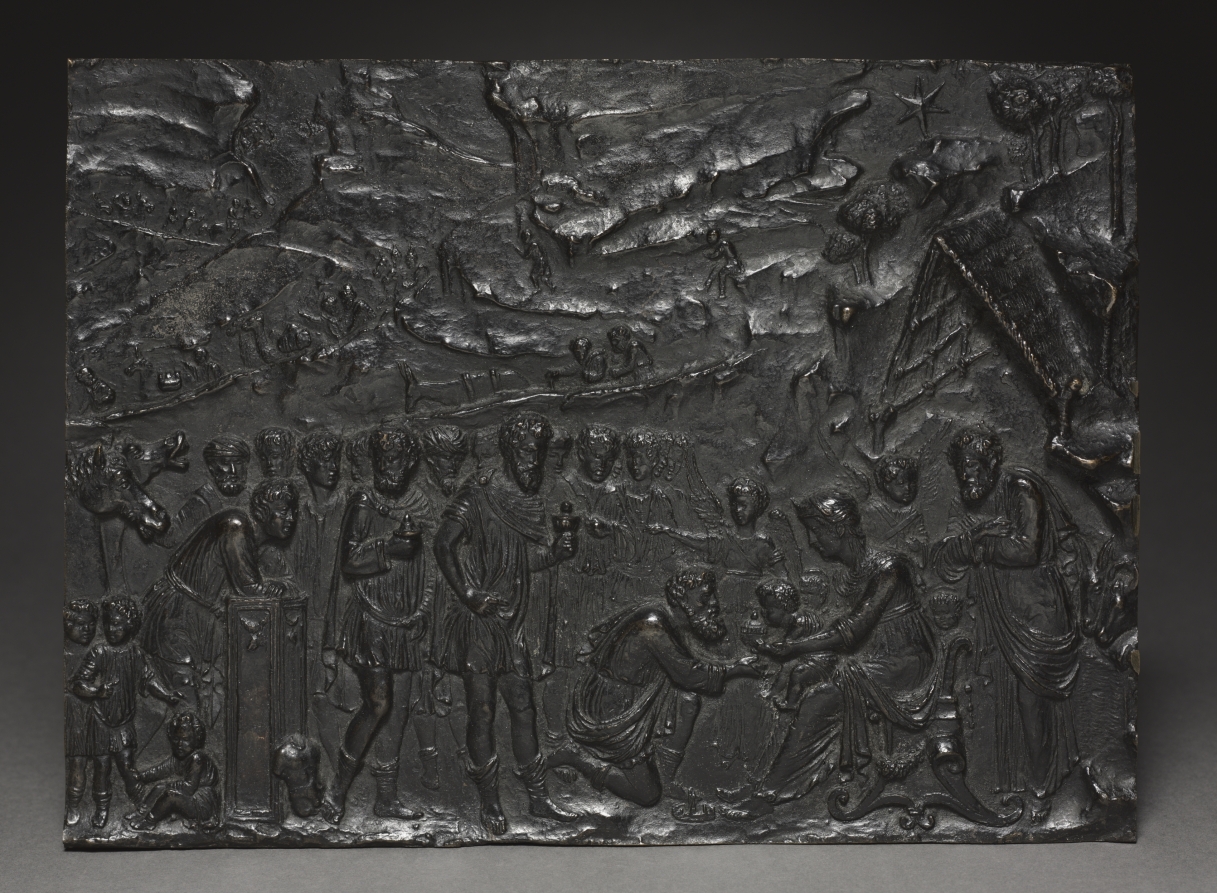
Adoration of the Magi
Giulio della TorreLinkedCulture matchlcp-c73d63a2d31f
- Date
- c. 1500–1525
- Medium
- bronze
- Culture
- Italy, first quarter 16th century
- Department
- European Painting and Sculpture
- Institution
- Cleveland Museum of Art
- Object ID
- 132046
From the Cleveland Museum of Art record
Figures leading livestock descend the winding rocky landscape in the background while in the foreground, a crowd gathers before the Holy Family. The traveling figures compose the majority of this plaque, communicating the haste and urgency on their journey to see Christ. Above the Holy Family, a rustic hut creates a canopy. The Madonna and Child sit prominently at the right on a Renaissance bench, receiving the Three Kings. The first king kneels as the Christ Child bends to accept the gift. Joseph stands cross-armed behind the Madonna with two winged angels at his side. Behind him are the heads of an ox and an ass, traditional elements of nativity scenes. To the left three children play while a youth leans on a pagan altar. The torso of an ancient sculpture lies on the ground before it, demonstrating that Christ has come to replace the ancient gods. This low-relief plaque was once believed to have been destroyed in 1914 but is now thought to have been a part of the Count W. Pourtalès collection in St. Petersburg, Russia. Adoration of the Magi resembles a 1506 relief by Riccio made for the Easter Candle in the Basilica of St. Anthony in Padua.
The authoritative record is held by Cleveland Museum of Art. LinkedCulture surfaces this object and its connections; it does not alter institutional metadata.
Get printable QR codesHide QR codes
Open QR codes for this object page and the museum record. They stay collapsed until needed.
Provenance & credit
As published by the source institution. Coverage varies — not every institution's open-data feed includes ownership history.
- Credit line
- John L. Severance Fund
- Provenance
- Possibly Marco Benavides, 1489-1582 (Padua, Italy) | By 1899. Probably Count Friedrich von Pourtales, 1853-1928 (St. Petersburg, Russia, and Berlin, Germany). | by 1953 - 1954 Dr. Jacob Hirsch (New York, New York), sold to the Cleveland Museum of Art, 1954.
Related across collections
Semantically similar works from Cleveland Museum of Art and other institutions.