Cleveland Museum of Art
Saint Eustace
Albrecht DürerLinkedCulture matchlcp-91cf98b472c5
- Date
- c. 1501
- Medium
- engraving
- Culture
- Germany, late 15th-early 16th Century
- Department
- Prints
- Institution
- Cleveland Museum of Art
- Object ID
- 135062
From LinkedCulture
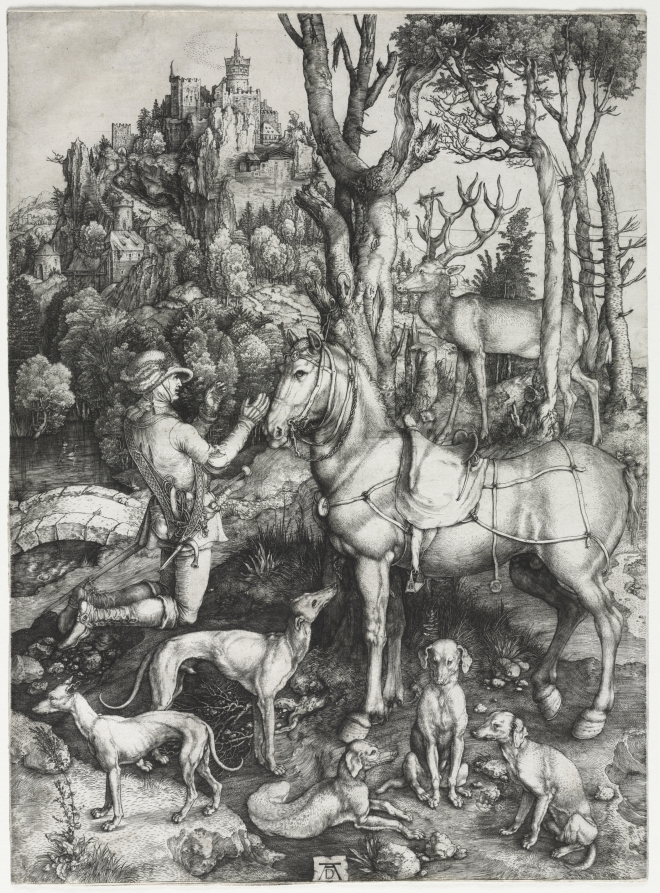
A glowing crucifix appears between a stag's antlers, and a Roman general falls to his knees - that's the moment Albrecht Dürer captured in his largest engraving, made around 1501. Five hunting dogs are arranged in the foreground, each posed at a different angle, turning them into a study of the canine body in motion. The sheen on the horse's flanks and the intricate forest textures behind them prove that engraving could match painting in its command of light and surface. This single print became a landmark in the history of the medium.
Written by LinkedCulture for its video on this object. Machine-generated (claude-sonnet-4-6), not yet reviewed by a person. It is not part of the museum’s record.
What the image shows
A man on horseback kneels beside his horse, surrounded by hunting dogs in a forested area with a castle in the distance.
Generated by LinkedCulture from the photograph alone, without the museum’s catalogue text (Qwen/Qwen2.5-VL-7B-Instruct), and not yet reviewed by a person. It describes the picture, not the object’s history, and it is not part of the museum’s record.
From the Cleveland Museum of Art record
Here, an encounter with nature dramatically alters a man’s journey through life. After Roman general Placidas tracked a stag in the forest, he saw a miraculous apparition of a crucifix between its horns. The miracle resulted in the general’s (thereafter Saint Eustace) immediate conversion to Christianity. Albrecht Dürer’s largest engraving demonstrates his mastery of tonal values and textures. His intense interest in nature’s variety makes finding the crucifix a kind of treasure hunt. Dürer took particular interest in the hunting dogs by carefully posing them to show five different aspects of the canine figure. The artist showed an interest in how bodies move in space by depicting a hunting dog five times from different angles.
The authoritative record is held by Cleveland Museum of Art. LinkedCulture surfaces this object and its connections; it does not alter institutional metadata.
Get printable QR codesHide QR codes
Open QR codes for this object page and the museum record. They stay collapsed until needed.
Provenance & credit
As published by the source institution. Coverage varies — not every institution's open-data feed includes ownership history.
- Credit line
- Bequest of Leonard C. Hanna Jr.
- Provenance
- ?–1958: Estate of Leonard C. Hanna, Jr., Cleveland, OH, given to The Cleveland Museum of Art, Cleveland, OH | November 29, 1958–: The Cleveland Museum of Art, Cleveland, OH
Related across collections
Semantically similar works from Cleveland Museum of Art and other institutions.