Cleveland Museum of Art
Adam and Eve
Albrecht DürerLinkedCulture matchlcp-91cf98b472c5
- Date
- 1504
- Medium
- engraving
- Culture
- Germany, early 16th Century
- Department
- Prints
- Institution
- Cleveland Museum of Art
- Object ID
- 135067
From LinkedCulture
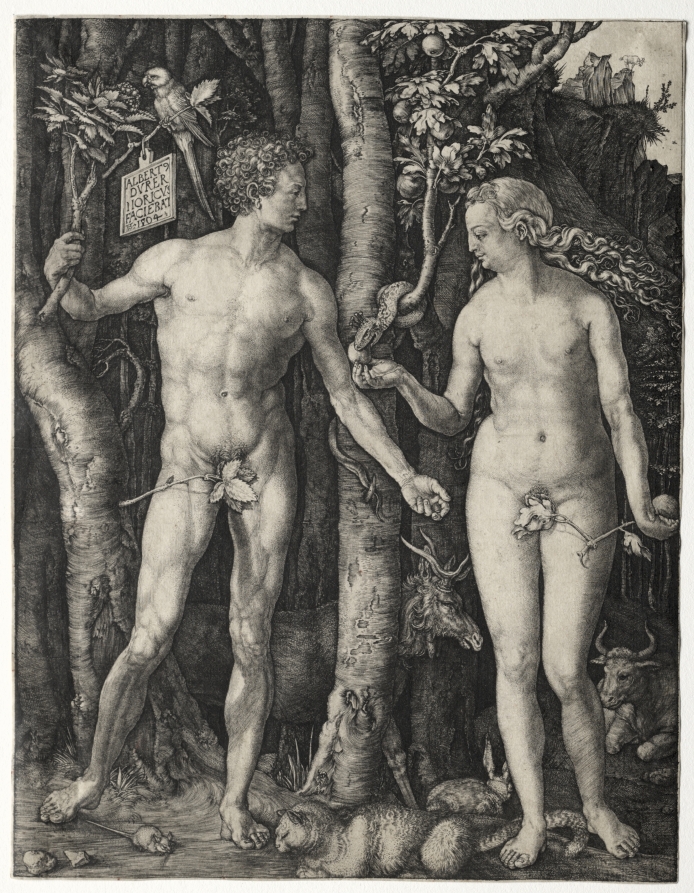
Just before the first bite, Adam and Eve exist in a state of total perfection, and Dürer used that single frozen moment to attempt something radical. In this 1504 engraving, he constructed both figures using a mathematical system of proportion, modeling Adam's pose directly on the ancient Roman Apollo Belvedere. A parrot perches on a branch above Adam's hand, a serpent coils through the tree beside Eve, and animals gather in the shadowed ground below. For Dürer, depicting sinless bodies was a pathway to understanding divine creation itself.
Written by LinkedCulture for its video on this object. Machine-generated (claude-sonnet-4-6), not yet reviewed by a person. It is not part of the museum’s record.
What the image shows
Adam and Eve stand in a forested area, holding hands, with a snake and fruit in the background.
Generated by LinkedCulture from the photograph alone, without the museum’s catalogue text (Qwen/Qwen2.5-VL-7B-Instruct), and not yet reviewed by a person. It describes the picture, not the object’s history, and it is not part of the museum’s record.
From the Cleveland Museum of Art record
Dürer based Adam’s pose on the Apollo Belvedere, a Roman sculpture discovered in Italy during the late 1400s. He constructed the idealized bodies of Adam and Eve using geometry and a mathematical system of proportion loosely derived from ancient models. For Dürer, who mostly depicted Christian subjects, the creation of theoretically perfect human bodies was a pathway to comprehending the divine. He thus represented Adam and Eve as he understood them in both theological and artistic terms: moments before tasting the forbidden fruit, they are still uncorrupted by sin and death, existing in a state of faultless beauty.
The authoritative record is held by Cleveland Museum of Art. LinkedCulture surfaces this object and its connections; it does not alter institutional metadata.
Get printable QR codesHide QR codes
Open QR codes for this object page and the museum record. They stay collapsed until needed.
Provenance & credit
As published by the source institution. Coverage varies — not every institution's open-data feed includes ownership history.
- Credit line
- Bequest of Leonard C. Hanna Jr.
Related across collections
Semantically similar works from Cleveland Museum of Art and other institutions.