Cleveland Museum of Art
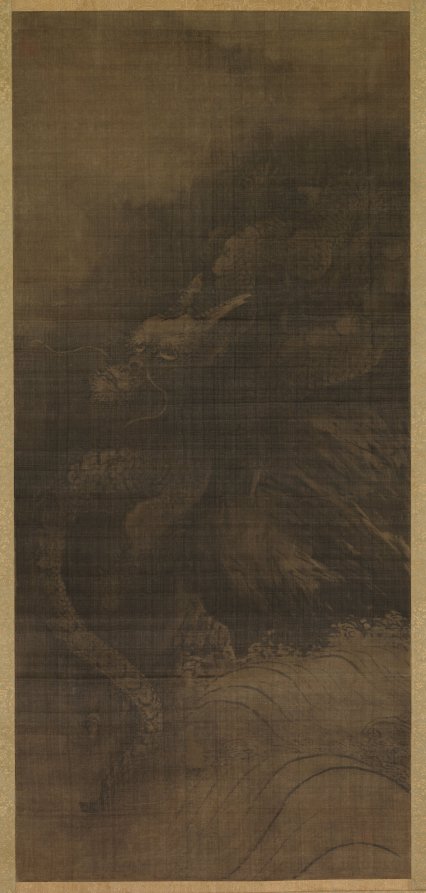
Dragon
Fachang MuqiLinkedCulture matchlcp-c5316b349407
- Date
- c. 1250–79
- Medium
- Hanging scroll; ink on silk
- Culture
- China, Southern Song dynasty (1127-1279)
- Department
- Chinese Art
- Institution
- Cleveland Museum of Art
- Object ID
- 135431
From the Cleveland Museum of Art record
The dragon and tiger are tied to the philosophical concept of yin and yang, which describes opposite but complementary forces. The dragon occupies a tiered background of waves and mist. Its luminous head emerges from the darker passages, and its narrow twisting body is serpent-like. By contrast, the close-up view of the tiger emphasizes its bulk. The tiger bends its head to lick its paw while its tail curls in the foreground. In their original Chan Buddhist context, this pair of scrolls likely flanked a central image, like the Bodhisattva Guanyin. The silk has darkened over the centuries, and the slight reddish shading in the tiger’s tongue and nose has faded. Fachang Muqi was a Chinese Chan Buddhist monk and painter.
The authoritative record is held by Cleveland Museum of Art. LinkedCulture surfaces this object and its connections; it does not alter institutional metadata.
Get printable QR codesHide QR codes
Open QR codes for this object page and the museum record. They stay collapsed until needed.
Provenance & credit
As published by the source institution. Coverage varies — not every institution's open-data feed includes ownership history.
- Credit line
- Purchase from the J. H. Wade Fund
- Provenance
- Ashikaga Yoshimitsu 足利義滿 [1358–1408] | Ashikaga Yoshinori 足利義教 [1394–1441] or 足利義政 [1436–1490] (Zakka shitsu yin 雜華室印) | Tokugawa Iemitsu 德川家光 [1604–1651] | Viscount Sakai 子爵 酒井氏 [late 1800s–early 1900s] | ?-1958: (Howard Hollis and Company, Cleveland, OH, sold to the Cleveland Museum of Art) | 1958-: The Cleveland Museum of Art, Cleveland, OH
Related across collections
Semantically similar works from Cleveland Museum of Art and other institutions.