Cleveland Museum of Art
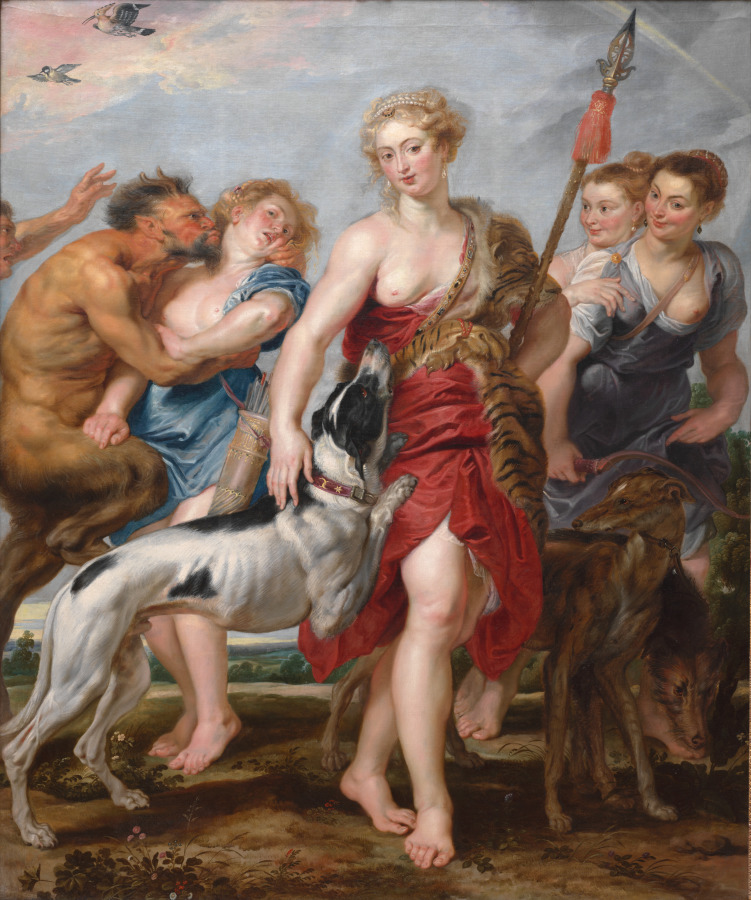
Diana and Her Nymphs Departing for the Hunt
Peter Paul RubensLinkedCulture matchlcp-e595aa3a83f9
- Date
- c. 1615
- Medium
- oil on canvas
- Culture
- Flanders
- Department
- European Painting and Sculpture
- Institution
- Cleveland Museum of Art
- Object ID
- 135661
From the Cleveland Museum of Art record
Diana, the Roman goddess of the hunt, wears a crescent on her forehead, also identifying her as the moon goddess. Diana lived apart from men, accompanied by a group of nymphs; she often represented unattainable beauty or chastity. With a nymph at left fending off a lustful satyr, Rubens refers to a struggle between vice and virtue, combining a sensual display of female bodies with a moral undertone. To bring the viewer more fully into the narrative, Rubens pulls the full-bodied figures to the front of the picture plane, and Diana steps forward, activating the space between viewer and subject. The nymph at the right has the features of Isabella Brant, the artist’s wife, and can be compared with Rubens’s portrait of her, also in the museum's collection. The moon and stars on the white and black dog’s collar indicate that both hounds are companions of Diana, accompanying the goddess on her hunts.
The authoritative record is held by Cleveland Museum of Art. LinkedCulture surfaces this object and its connections; it does not alter institutional metadata.
Get printable QR codesHide QR codes
Open QR codes for this object page and the museum record. They stay collapsed until needed.
Provenance & credit
As published by the source institution. Coverage varies — not every institution's open-data feed includes ownership history.
- Credit line
- Leonard C. Hanna Jr. Fund
- Provenance
- 1959-: The Cleveland Museum of Art, Cleveland, Ohio | 1959: (Rosenberg & Stiebel, New York, NY, sold to the Cleveland Museum of Art) | 1948-1959: Édouard [1868-1949] and Germaine [1884-1975] de Rothschild, Chantilly, sold to Rosenberg & Stiebel through Robert Leclerc1 | 1945-1948: In possession of the Allies; restituted to Édouard and Germaine de Rothschild1 | 1942-1945: In possession of Hermann Goering [1893-1946], probably Carinhall, Brandenburg1 | 1940-1942: In possession of the Einsatzstab Reichsleiter Rosenberg (ERR), selected by Hermann Goering for his collection1 | Probably 1905-1940: Édouard [1868-1949] and Germaine [1884-1975] de Rothschild, Ferrières, confiscated by the Einsatzstab Reichsleiter Rosenberg (ERR)1 | Probably by 1899-1905: Mayer Alphonse de Rothschild [1827-1905], Ferrières, by descent to his son, Édouard de Rothschild | 1873-probably by 1889: Thomas George Baring, First Earl of Northbrook [1826-1904], sold to Mayer Alphonse de Rothschild1 | By 1857-1873: Thomas Baring, Esq. [1799-1873], London, by descent to his nephew Thomas George Baring1 | 1840-by 1854: C. Nieuwenhuys, sold to Thomas Baring | 1840: (Clarke sale, Christie's, London, May 8-9, 1840, no. 52, sold to C. Nieuwenhuys) | 1803-1840: Sir Simon H. Clarke, 10th Baronet Clarke [1818-1849], Oakhill, Hertfordshire | 1803: (Sale, Greenwood & Co., London, Feb. 19, 1803, probably sold to Simon H. Clarke)1 | 1802-1803: (Michael Bryan, London?)1 | 1802: (Clarke/Hibbert sale, Christie's, London, May 14-15, 1802, no. 71, sold to Michael Bryan)1 | Probably 1798-1802: Sir Simon Haughton Clarke, 9th Baronet Clarke [1764-1832], Oakhill, Hertfordshire, and George Hibbert [1757-1837]1 | 1798: (Coxe, Burrel & Foster, London, Bryan sale, May 17, 1798, no. 42, sold to Simon H. Clarke)1 | Until 1798: Michael Bryan [1757 – 1821], London1 | 1796=: Van Coevorden1 | 1796: (C. Blasius, et.al., Amsterdam, Hooft estate sale, August 31, 1796, no. 32, sold to van Coevorden) | 1784-1796: Elisabeth Hooft [c. 1711-1796], Amsterdam | Until 1784: Wouter Valckenier and family [1705-1784], Amsterdam, by descent to his widow, Elisabeth Hooft
Related across collections
Semantically similar works from Cleveland Museum of Art and other institutions.