Cleveland Museum of Art
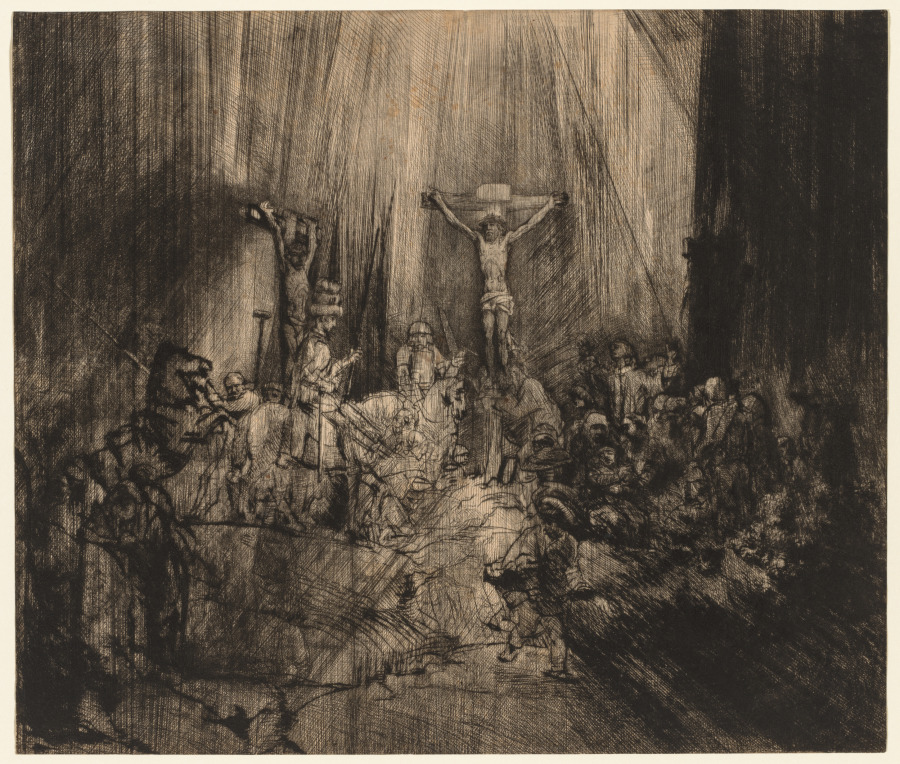
Christ Crucified Between the Two Thieves: 'The Three Crosses'
Rembrandt van RijnLinkedCulture matchlcp-adad34d778fc
- Date
- 1653-c.1660
- Medium
- drypoint
- Culture
- Rembrandt, 17th century
- Department
- Prints
- Institution
- Cleveland Museum of Art
- Object ID
- 135706
What the image shows
A dramatic etching depicting the crucifixion of Jesus Christ surrounded by soldiers and onlookers.
Generated by LinkedCulture from the photograph alone, without the museum’s catalogue text (Qwen/Qwen2.5-VL-7B-Instruct), and not yet reviewed by a person. It describes the picture, not the object’s history, and it is not part of the museum’s record.
From the Cleveland Museum of Art record
Rembrandt’s Christ Crucified Between the Two Thieves is executed entirely in drypoint. Because of the delicacy of the technique, the copper plate was worn after the artist printed about 40 impressions of the first three states. In order to continue using the plate, Rembrandt reworked it, changing the image somewhat. In this fourth state, slashing strokes obscure the spectators visible in the earlier version, creating a tenebrous setting that focuses attention on Christ bathed in celestial light. Although drypoint is an inherently linear medium, Rembrandt used it to obtain tonal qualities associated with painting. The blackness becomes an active force that threatens to extinguish the light of Christ—a literal illustration of the Evangelist Luke’s description of the event that brought "a darkness over all the earth." When he printed this impression, Rembrandt deliberately left ink on the printing plate, specifically on the left and right sides, essentially creating a unique work.
The authoritative record is held by Cleveland Museum of Art. LinkedCulture surfaces this object and its connections; it does not alter institutional metadata.
Get printable QR codesHide QR codes
Open QR codes for this object page and the museum record. They stay collapsed until needed.
Provenance & credit
As published by the source institution. Coverage varies — not every institution's open-data feed includes ownership history.
- Credit line
- Bequest of Ralph King and Purchase from the J. H. Wade Fund
Related across collections
Semantically similar works from Cleveland Museum of Art and other institutions.