Cleveland Museum of Art
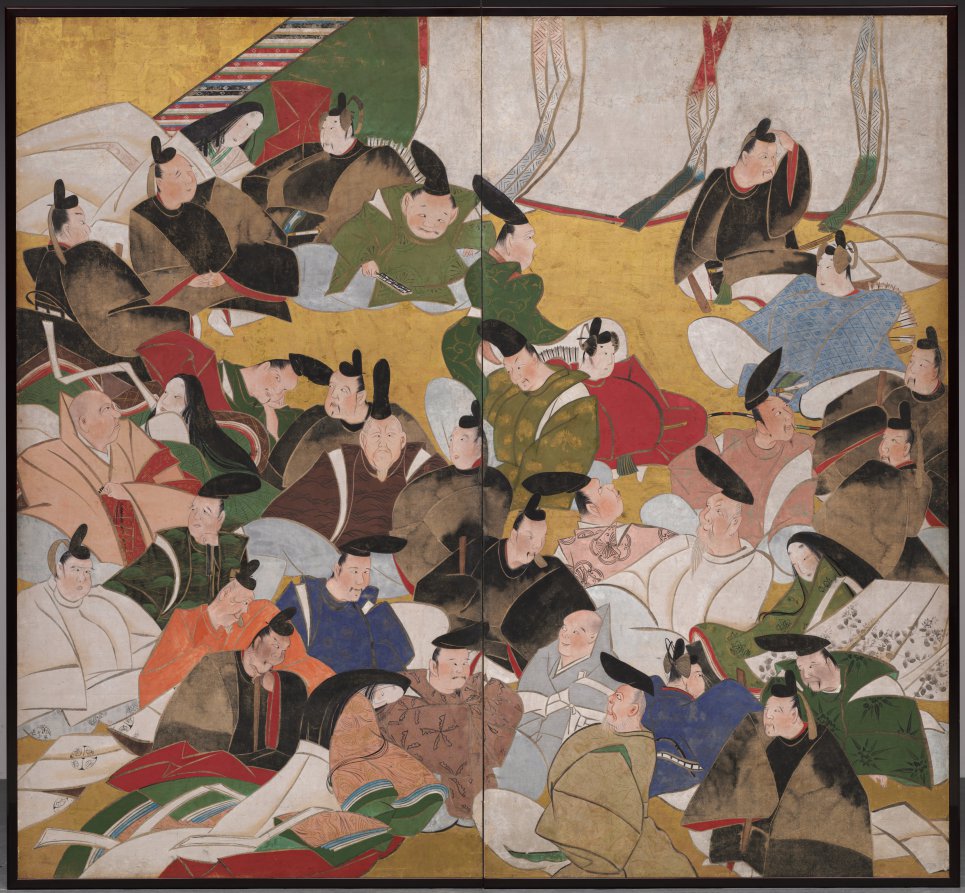
Thirty-Six Poetic Immortals
Tatebayashi KageiLinkedCulture matchlcp-a13cd8f851a7
- Date
- mid 1700s
- Medium
- two-fold screen; ink, color, and gold on paper
- Culture
- Japan, Edo period (1615–1868)
- Department
- Japanese Art
- Institution
- Cleveland Museum of Art
- Object ID
- 136297
From the Cleveland Museum of Art record
Fujiwara no Kintō (996–1075), a Japanese courtier, scholar, and poet, compiled select examples by the most celebrated composers of 31-syllable poems ( waka ) from the 600s to the 1000s. Painters soon made these “thirty-six poetic immortals” a favorite subject, traditionally presenting the poets in sequential, idealized portraits paired with their poems. In this interpretation, a chronologically impossible gathering of these great talents is in progress. The screen’s composition follows one devised by design virtuoso Ogata Kōrin (1658–1716). The green surface edged with stripes at the upper left of the painting represents tatami matting with a silk border.
The authoritative record is held by Cleveland Museum of Art. LinkedCulture surfaces this object and its connections; it does not alter institutional metadata.
Get printable QR codesHide QR codes
Open QR codes for this object page and the museum record. They stay collapsed until needed.
Provenance & credit
As published by the source institution. Coverage varies — not every institution's open-data feed includes ownership history.
- Credit line
- Mr. and Mrs. William H. Marlatt Fund
- Provenance
- ?–1960: (Victor L. Hauge [1919–2013], Falls Church, VA, sold to the Cleveland Museum of Art) | 1960–: The Cleveland Museum of Art, Cleveland, OH
Related across collections
Semantically similar works from Cleveland Museum of Art and other institutions.