Cleveland Museum of Art
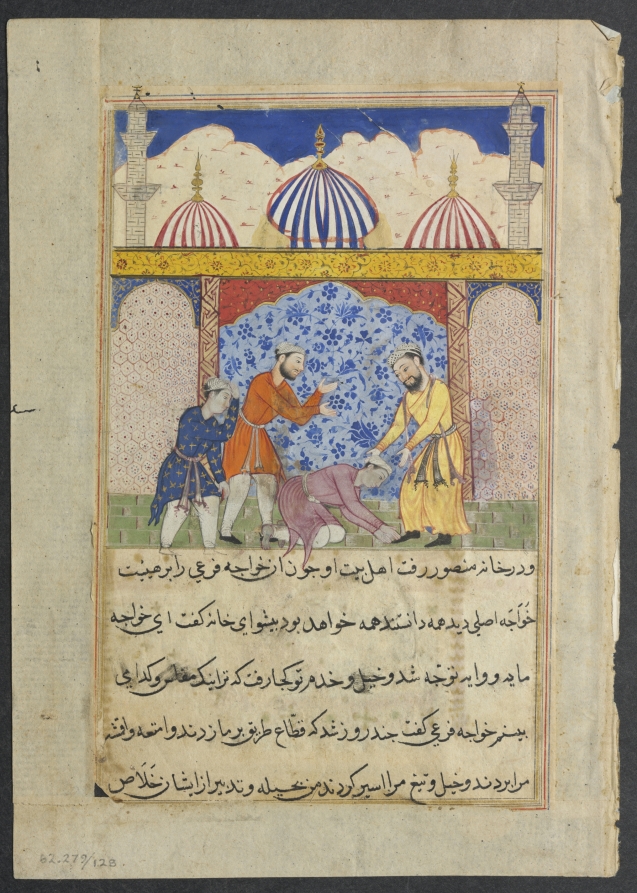
The young man, who has magically taken on the appearance of Mansur the merchant, arrives at his home, from a Tuti-nama (Tales of a Parrot): Seventeenth Night
- Date
- c. 1560
- Medium
- gum tempera, ink, and gold on paper
- Culture
- Mughal India, court of Akbar (reigned 1556–1605)
- Department
- Indian and Southeast Asian Art
- Institution
- Cleveland Museum of Art
- Object ID
- 137420
From the Cleveland Museum of Art record
After receiving a magical epithet from a monk, the lascivious young man transformed his appearance into that of Mansur, the merchant, in order to go to bed with Manur’s wife. The imposter, dressed in yellow at the right, is welcomed home by members of Mansur’s household. They are distressed that he has returned unexpectedly without his horse, assistants, or belongings. The magical, wish-fulfilling epithet derives from the names of God.
The authoritative record is held by Cleveland Museum of Art. LinkedCulture surfaces this object and its connections; it does not alter institutional metadata.
Get printable QR codesHide QR codes
Open QR codes for this object page and the museum record. They stay collapsed until needed.
Provenance & credit
As published by the source institution. Coverage varies — not every institution's open-data feed includes ownership history.
- Credit line
- Gift of Mrs. A. Dean Perry
- Provenance
- ?–1959: Estate of Breckinridge Long [1881–1958], Bowie, MD | 1959–1962?: (Harry Burke Antiques, Philadelphia, PA) | 1959?–1962: (Bernard Brown Agency, Milwaukee, WI, sold to the Cleveland Museum of Art. Purchased with funds from Mrs. A. Dean [Helen Wade Greene] Perry) | 1962–: The Cleveland Museum of Art, Cleveland, OH
Related across collections
Semantically similar works from Cleveland Museum of Art and other institutions.