Cleveland Museum of Art
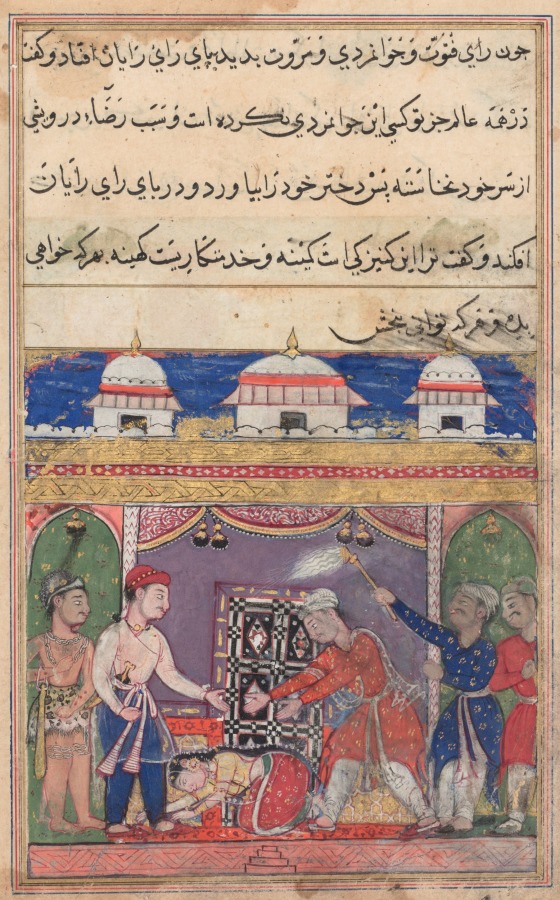
The king of Bahilistan offers his daughter to the King of Kings, from a Tuti-nama (Tales of a Parrot): Seventh Night
- Date
- c. 1560
- Medium
- gum tempera, ink, and gold on paper
- Culture
- Mughal India, court of Akbar (reigned 1556–1605)
- Department
- Indian and Southeast Asian Art
- Institution
- Cleveland Museum of Art
- Object ID
- 137897
From the Cleveland Museum of Art record
The local king was so moved by the gesture of the King of King’s in support of the dervish and by his cleverness at bringing his own head, still attached, that he offered his daughter in marriage to him. The princess, wearing Indian dress, is shown honoring his feet. The male figures wear the Central Asian dress of the Mughals, with a long belted tunic and pants. The King of Kings then allowed her to marry the dervish. A fancy door with geometric patterns is in the background, but it extends all the way down to the front of the floor, which has been tilted up, so that the tile pattern can be seen head-on. These fanciful manipulations of space are a hallmark of local Indian artistic practice. The domed pavilions are typical features of Mughal architecture, with the pink sandstone eves.
The authoritative record is held by Cleveland Museum of Art. LinkedCulture surfaces this object and its connections; it does not alter institutional metadata.
Get printable QR codesHide QR codes
Open QR codes for this object page and the museum record. They stay collapsed until needed.
Provenance & credit
As published by the source institution. Coverage varies — not every institution's open-data feed includes ownership history.
- Credit line
- Gift of Mrs. A. Dean Perry
- Provenance
- ?–1959: Estate of Breckinridge Long [1881–1958], Bowie, MD | 1959–1962?: (Harry Burke Antiques, Philadelphia, PA) | 1959?–1962: (Bernard Brown Agency, Milwaukee, WI, sold to the Cleveland Museum of Art. Purchased with funds from Mrs. A. Dean [Helen Wade Greene] Perry) | 1962–: The Cleveland Museum of Art, Cleveland, OH
Related across collections
Semantically similar works from Cleveland Museum of Art and other institutions.