Cleveland Museum of Art
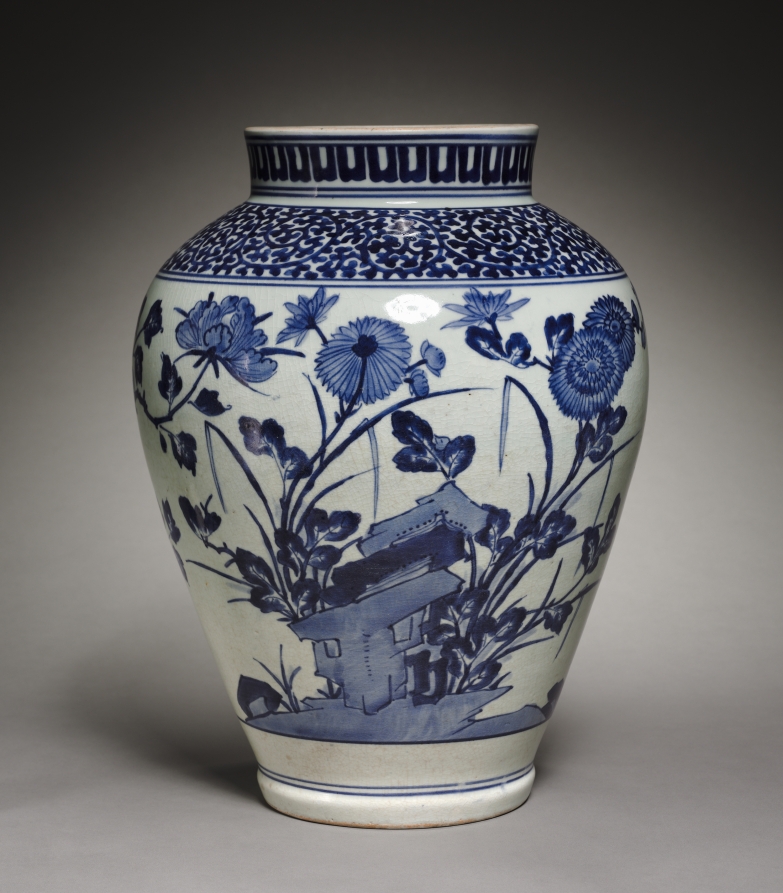
Large Jar with Peonies, Orchids, and Chrysanthemums
- Date
- late 1600s
- Medium
- Porcelain with underglaze blue decoration (Imari ware)
- Culture
- Japan, Edo period (1615–1868)
- Department
- Japanese Art
- Institution
- Cleveland Museum of Art
- Object ID
- 140301
From the Cleveland Museum of Art record
Spring peonies, summer orchids, and autumn chrysanthemums bloom at the same time amid garden rocks. These underglaze blue motifs were inspired by similar designs on Chinese ceramics made for export to Europe. In the early 1600s, Korean potters in Japan discovered kaolin, the clay essential for porcelain production. At the same time, political turmoil in China following the collapse of the Ming dynasty (1368–1644) disrupted Chinese exports. Together, these circumstances created an opportunity for Japan to supply ceramics to the European market. Careful study of Chinese prototypes shaped the work of Japanese ceramists for both domestic and overseas audiences. This design shows the changing of the seasons: one side depicts a peony blossom in the spring, and the other side continues with chrysanthemums and an orchid in the autumn.
The authoritative record is held by Cleveland Museum of Art. LinkedCulture surfaces this object and its connections; it does not alter institutional metadata.
Get printable QR codesHide QR codes
Open QR codes for this object page and the museum record. They stay collapsed until needed.
Provenance & credit
As published by the source institution. Coverage varies — not every institution's open-data feed includes ownership history.
- Credit line
- Severance and Greta Millikin Collection
- Provenance
- ?–1960: (Mayuyama & Co., Tokyo, Japan, sold to Severance and Greta Millikin) | 1960–1964: Severance A. [1895–1985] and Greta [Marguerite Steckerl] Millikin [1903–1989], Cleveland, OH, given to the Cleveland Museum of Art | 1964–: The Cleveland Museum of Art, Cleveland, OH
Related across collections
Semantically similar works from Cleveland Museum of Art and other institutions.