Cleveland Museum of Art
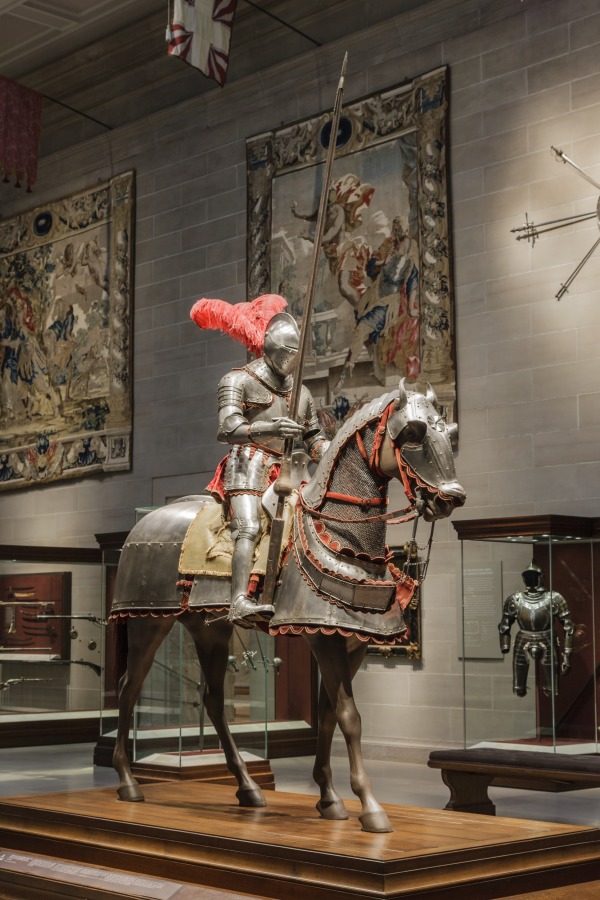
Armor for Man and Horse with Völs-Colonna Arms
- Date
- c. 1575
- Medium
- steel
- Culture
- North Italy, 16th century
- Department
- Medieval Art
- Institution
- Cleveland Museum of Art
- Object ID
- 141444
From the Cleveland Museum of Art record
A knight depended on his horse both as a weapon and a means of defense. He therefore had to take great care to protect his charger. From the 1100s on, knights first covered their steeds in trappings of fabric and later of mail. By around 1400, full steel plate armor for horses was complete. It is possible that this armor made for both man and horse originally belonged to a "garniture," an armor with multiple customized exchange elements that could convert the basic suit to various field and sporting uses. With different pieces of the garniture attached, this suit could have been worn either in battle or in various tournament games. The total combined weight of both the man's and horse's armor is 114 pounds. The etched decoration of this armor is of a type that became fashionable in northern Italy during the late 1500s. It consists of ornamental bands of etched figures, animals, portrait busts, and armor trophies. In addition, a coat of arms is represented seven times in different places—the center of the breastplate and blackplate, the front and back of each pauldron (shoulder defense), and the center of the peytral (horse's breastplate). The coat of arms is that of the Colonna family quartered with another, still unidentified family. It probably belonged to an unknown member of the Völs-Colonna family from the South Tyrol, now part of northern Italy. The Vols-Colonna family crest is found seven times in prominent locations on this armor set for horse and rider.
The authoritative record is held by Cleveland Museum of Art. LinkedCulture surfaces this object and its connections; it does not alter institutional metadata.
Get printable QR codesHide QR codes
Open QR codes for this object page and the museum record. They stay collapsed until needed.
Provenance & credit
As published by the source institution. Coverage varies — not every institution's open-data feed includes ownership history.
- Credit line
- John L. Severance Fund
- Provenance
- Schloss Prösels, Fiè allo Sciliar, Italy | ?-1832: Town Hall, Bolzano, Italy | 1832-: Prince Peter Soltykoff (active 1840-1861), Paris, France | -1913: William H. Rigs (1837-1928), Paris, France, donated to the Metropolitan Museum of Art | 1913-1964: The Metropolitan Museum of Art (1913-64), New York, NY, sold to the Cleveland Museum of Art | 1964-: The Cleveland Museum of Art, Cleveland, OH
Part of a LinkedCulture topic
 European Renaissance Armor Components
These objects are all pieces of defensive armor and military equipment from 15th-17th century Europe, primarily from major armoring centers like Italy, Germany, and France.
500 objects from 4 institutions
Related across collections
Semantically similar works from Cleveland Museum of Art and other institutions.