Cleveland Museum of Art
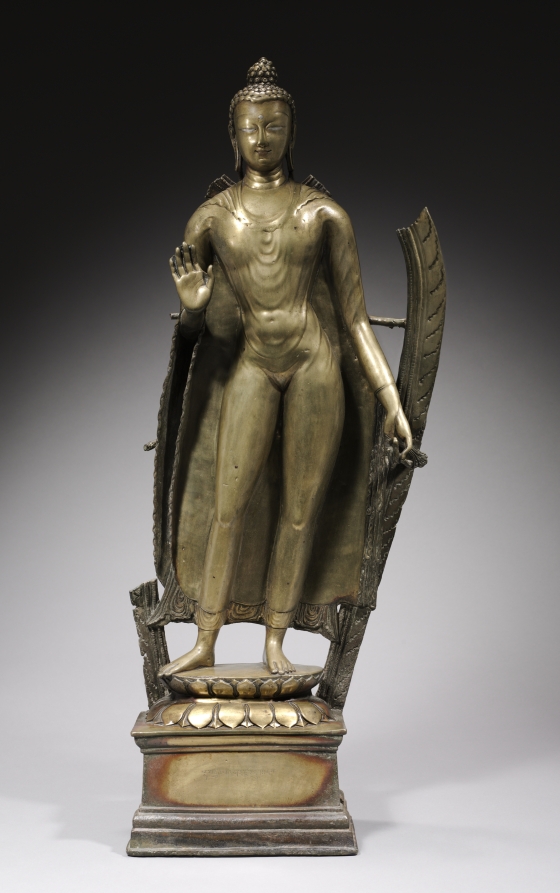
Standing Buddha
- Date
- c. 900
- Medium
- brass with silver and copper inlay
- Culture
- India, Kashmir
- Department
- Indian and Southeast Asian Art
- Institution
- Cleveland Museum of Art
- Object ID
- 142560
From the Cleveland Museum of Art record
The slender athletic Buddha extends one foot slightly off the lotus pedestal, suggesting his humanity enters our world from his transcendent state. With his right hand he signals that we should have no fear. The smooth signs of wear on the sculpture indicate that it was worshiped in Kashmir, where water and other ablutions were poured over sacred images during rituals. The Tibetan inscription on the pedestal states that it belonged to a royal monk named Nagaraja (Tibetan, active about 998–1026). Sculptures like this contributed to the transmission of Buddhism from India to Tibet and served as artistic models. The Buddha grasps the end of his robe in his left hand.
The authoritative record is held by Cleveland Museum of Art. LinkedCulture surfaces this object and its connections; it does not alter institutional metadata.
Get printable QR codesHide QR codes
Open QR codes for this object page and the museum record. They stay collapsed until needed.
Provenance & credit
As published by the source institution. Coverage varies — not every institution's open-data feed includes ownership history.
- Credit line
- John L. Severance Fund
- Provenance
- ?–1966: (J.J. Klejman [1906–1995], New York, NY, sold to the Cleveland Museum of Art) | 1966–: The Cleveland Museum of Art, Cleveland, OH
Related across collections
Semantically similar works from Cleveland Museum of Art and other institutions.