Cleveland Museum of Art
Flower Study of a Lowbush Cranberry or Lingonberry
House of FabergéLinkedCulture matchlcp-f2cad58269e3
- Date
- c. 1885–1915
- Medium
- chalcedony, jade, rock crystal, gold
- Culture
- Russia, St. Petersburg
- Department
- Decorative Art and Design
- Institution
- Cleveland Museum of Art
- Object ID
- 142737
What the image shows
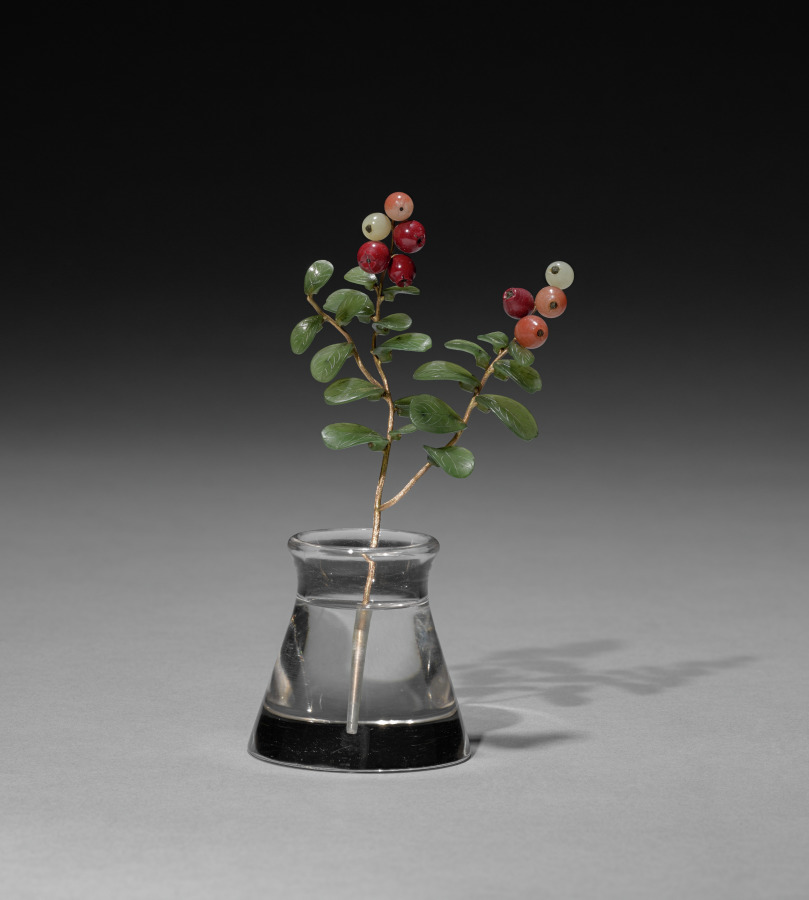
A small branch with green leaves and red berries is placed in a clear glass vase filled with water.
Generated by LinkedCulture from the photograph alone, without the museum’s catalogue text (Qwen/Qwen2.5-VL-7B-Instruct), and not yet reviewed by a person. It describes the picture, not the object’s history, and it is not part of the museum’s record.
From the Cleveland Museum of Art record
This flower study depicts a lowbush cranberry or lingonberry. To achieve a naturalistic effect of ripening fruit, Fabergé varied the coloring of the berries. Some are made of chalcedony in hues of milky white to represent unripe berries, while others appear in deep reddish agate to represent ripe ones. Fabergé’s inspiration for his flower studies is said to have come from the floral brooches of precious stones that were made in the 1700s for Catherine the Great as well as from the Japanese art of flower arranging, known as ikebana. Fabergé’s flower studies were given as intimate gifts to friends by the tsarina and others in the court. She also liked to take them around to wherever the imperial family was residing as a reminder of spring during the harsh Russian winters. The stems of Fabergé’s flower studies are set into little basins carved from rock crystal to resemble pots of water.
The authoritative record is held by Cleveland Museum of Art. LinkedCulture surfaces this object and its connections; it does not alter institutional metadata.
Get printable QR codesHide QR codes
Open QR codes for this object page and the museum record. They stay collapsed until needed.
Provenance & credit
As published by the source institution. Coverage varies — not every institution's open-data feed includes ownership history.
- Credit line
- The India Early Minshall Collection
- Provenance
- ?-1966: India Early Minshall [1885–1965], Cleveland, OH, bequest to the Cleveland Museum of Art | 1966-: The Cleveland Museum of Art, Cleveland, OH
Related across collections
Semantically similar works from Cleveland Museum of Art and other institutions.