Cleveland Museum of Art
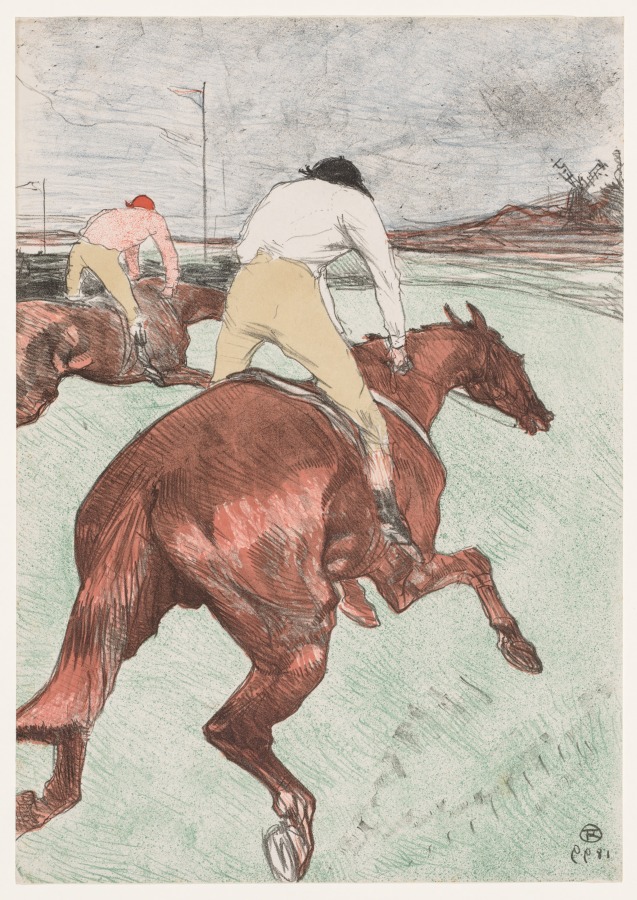
The Jockey
Henri de Toulouse-LautrecLinkedCulture matchlcp-83c094d8930a
- Date
- 1899
- Medium
- color lithograph
- Culture
- France, late 19th Century
- Department
- Prints
- Institution
- Cleveland Museum of Art
- Object ID
- 143299
From the Cleveland Museum of Art record
Motivated by the popularity of the races, Henri de Toulouse-Lautrec executed this lithograph both in color, seen here, and in black and white. He intended to publish the color version in a portfolio of horse-racing subjects, but the project never came to fruition and Jockey was published alone. The artist's admiration for Edgar Degas's horse-racing pictures is clear in Jockey , and he shared Degas's appreciation of Japanese ukiyo-e woodblock prints. Particular elements of the lithograph reveal the influence of the Japanese woodcut: the overall flatness; the daring cropping—particularly of the background horse whose head and hindquarters have been omitted; the pale green hue of the grass and the blue-violet sky; and the dramatic, rushing perspective of the horses galloping into the distance. However, the younger artist incorporated the Japanese aesthetic into his own visual language in an entirely original way. Unlike Degas, Toulouse-Lautrec ignored Eadweard Muybridge's photographs and depicted his horse and rider in the physically impossible "flying-gallop" position. Henri de Toulouse-Lautrec set this print at an identifiable race track, at Longchamps in Paris's Bois de Boulougne.
The authoritative record is held by Cleveland Museum of Art. LinkedCulture surfaces this object and its connections; it does not alter institutional metadata.
Get printable QR codesHide QR codes
Open QR codes for this object page and the museum record. They stay collapsed until needed.
Provenance & credit
As published by the source institution. Coverage varies — not every institution's open-data feed includes ownership history.
- Credit line
- Mr. and Mrs. Charles G. Prasse Collection
Related across collections
Semantically similar works from Cleveland Museum of Art and other institutions.