Cleveland Museum of Art
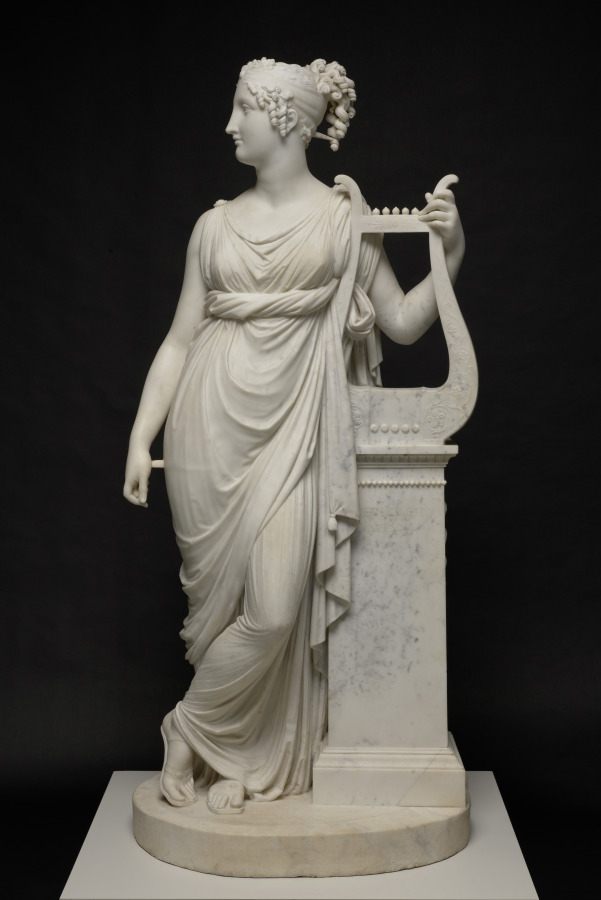
Terpsichore Lyran (Muse of Lyric Poetry)
Antonio CanovaLinkedCulture matchlcp-f237913ca93d
- Date
- 1816
- Medium
- marble
- Culture
- Italy, 19th century
- Department
- Modern European Painting and Sculpture
- Institution
- Cleveland Museum of Art
- Object ID
- 143775
From the Cleveland Museum of Art record
In Greek mythology, Terpsichore was one of the nine Muses, or goddesses of creative inspiration. The lyre, the Greek inscription on the short column, and the caduceus (entwined snakes) on the side identify the figure as Terpsichore Lyran, muse of lyric poetry. This sculpture began with a commission from Napoleon's brother, Lucien, for an idealized portrait of his wife, Alexandrine. Antonio Canova made this version for a British aristocrat and exhibited it in 1817 at the Royal Academy in London to great acclaim. Trained by his grandfather, an Italian stonemason, Canova began modeling clay and carving marble sculptures before age ten.
The authoritative record is held by Cleveland Museum of Art. LinkedCulture surfaces this object and its connections; it does not alter institutional metadata.
Get printable QR codesHide QR codes
Open QR codes for this object page and the museum record. They stay collapsed until needed.
Provenance & credit
As published by the source institution. Coverage varies — not every institution's open-data feed includes ownership history.
- Credit line
- Leonard C. Hanna Jr. Fund
- Provenance
- Simon H. Clarke, 9th Bt., 1764-1832 (Oak Hill, East Barnet, England); | Alfred de Rothschild, 1842-1918 (Halton, Buckinghamshire, England), by inheritance to his nephew, Lionel de Rothschild, 1918; | Lionel Nathan de Rothschild, 1882-1942 (Exbury, Hampshire, England), 1918-1942, by inheritance to his first son, Edmund Leopold de Rothschild, 1942; | Edmund Leopold de Rothschild, born 1916 (Exbury, Hampshire, England), sold to Wildenstein & Co., 1963; | Wildenstein & Co. (New York, New York), sold to the Cleveland Museum of Art, 1968. | 1968-: The Cleveland Museum of Art, Cleveland, OH
Related across collections
Semantically similar works from Cleveland Museum of Art and other institutions.